
Best overall: the Zarit Burden Interview. Best for identifying practical caregiving strain: the Modified Caregiver Strain Index. Best for a health-focused conversation: the American Medical Association Caregiver Self-Assessment Questionnaire. This 2026 caregiver burnout quiz guide compares those tools with the WHO-5 Well-Being Index and an unscored daily check-in, so you can choose an assessment and turn your answers into a request for support.
- The Zarit Burden Interview is the best caregiver burnout quiz starting point for understanding family caregiving burden.
- The Modified Caregiver Strain Index helps identify pressures involving time, sleep, work, and finances.
- The WHO-5 measures well-being, not caregiving burden; use it when your own emotional health needs attention.
- Pdfcanopy offers caregiver burnout guides for parents of neurodivergent children, not clinical screening or diagnosis.
Why this matters
You do not need a high score to deserve a break. A caregiver burnout quiz gives you language for what is becoming difficult; it does not decide whether your struggle counts.
The important distinction in 2026 is burden versus well-being. A burden questionnaire asks how caregiving affects your life. A well-being questionnaire asks how you feel, without necessarily explaining why. Neither replaces a medical or mental health assessment.
Pdfcanopy sells downloadable advice guides, including caregiver burnout information for parents of neurodivergent children. Those guides belong in the coping-information category, not the diagnostic-testing category.
What makes the best caregiver burnout quiz?
Choose a tool that helps you take the next step, not just collect a label.
- Purpose: Does it assess caregiving burden, practical strain, or emotional well-being? These are related but different questions.
- Recognizable source: Look for the named questionnaire and its original instructions rather than an anonymous quiz with unexplained scoring.
- Clear interpretation: The result should explain what the score measures without declaring a diagnosis.
- Relevant questions: Family caregiving and paid nursing work are different settings. Choose questions that fit your responsibilities.
- Actionable answers: A useful result helps you identify something to discuss, delegate, or change.
- Privacy: Read how a website handles your answers before entering sensitive information about yourself or the person you support.
Caregiver self-assessment tools at a glance
These options serve different purposes. The ranking favors caregiving-specific tools first, then broader well-being assessment and everyday reflection.
| Rank and tool | Best for | Standout feature | Key limitation |
|---|---|---|---|
| 1. Zarit Burden Interview | Understanding overall family caregiving burden | The commonly used full version has 22 items | Burden is not the same as a burnout diagnosis |
| 2. Modified Caregiver Strain Index | Identifying practical pressures to address | Covers several areas of caregiving strain | Does not provide a complete mental health assessment |
| 3. AMA Caregiver Self-Assessment Questionnaire | Preparing a conversation about your own health | An 18-item caregiver-focused questionnaire | Interpretation requires the questionnaire's instructions |
| 4. WHO-5 Well-Being Index | Checking broader emotional well-being | Five items about the previous two weeks | Does not identify caregiving-specific causes |
| 5. Unscored daily caregiver check-in | Choosing an immediate support request | Turns observations into a next action | Not a validated screening instrument |
1. Zarit Burden Interview: best for overall caregiving burden
The Zarit Burden Interview asks how caregiving affects your emotional, social, and practical life. It is the strongest default choice here when you want to understand the weight of family caregiving rather than complete a general wellness quiz.
The commonly used full version has 22 items, each scored from 0 to 4, for a total from 0 to 88 points. Shorter versions also exist, so confirm which version you are using before interpreting the result.
Zarit Burden Interview pros:
- Focuses directly on the experience of caring for another person.
- Gives you a structured way to describe pressures that are hard to explain aloud.
- Produces a score you can discuss with a healthcare professional.
Zarit Burden Interview cons:
- A burden score does not diagnose burnout, depression, or anxiety.
- Different versions need their own scoring instructions.
- A total score cannot show every practical problem that needs attention.
Best for: Family caregivers who want a broad picture of how caregiving affects their lives.
After completing the Zarit Burden Interview, note which questions felt most relevant. Bring those examples—not only the total—to a conversation about support. Feeling unable to leave the house requires a different response from struggling with guilt, even if both contribute to burden.
Verdict: Use the Zarit Burden Interview as your default starting point for family caregiving burden.
2. Modified Caregiver Strain Index: best for practical pressure points
The Modified Caregiver Strain Index helps you examine the areas of life affected by caregiving. Its questions cover pressures such as disturbed sleep, physical strain, financial strain, and changes to personal plans.
The instrument has 13 items. Responses receive 0, 1, or 2 points, producing a total from 0 to 26 points. Follow the modified version's instructions; the original Caregiver Strain Index uses a different response format.
Modified Caregiver Strain Index pros:
- Connects caregiving strain with recognizable everyday problems.
- Distinguishes between strain that occurs sometimes and strain that occurs regularly.
- Helps you prepare specific requests about tasks, schedules, or resources.
Modified Caregiver Strain Index cons:
- The score does not diagnose a mental health condition.
- Identifying a pressure does not establish which support will resolve it.
- Confusing the original and modified versions leads to incorrect scoring.
Best for: Caregivers who need to explain what is becoming unmanageable in daily life.
Use your answers to choose a concrete conversation topic. If interrupted sleep stands out, discuss overnight responsibilities. If work disruption stands out, discuss appointment coverage or scheduling help rather than treating the whole problem as a need for better relaxation.
Verdict: Use the Modified Caregiver Strain Index when you need to turn strain into specific support requests.
3. AMA Caregiver Self-Assessment: best for a health conversation
The American Medical Association Caregiver Self-Assessment Questionnaire directs attention back to the caregiver. It asks about experiences and feelings that help you consider how caregiving is affecting your own health.
This 18-item questionnaire is a useful starting point when you have been focused on someone else's appointments while postponing your own. Keep its interpretation instructions alongside your answers rather than relying on a website's summary label.
AMA Caregiver Self-Assessment Questionnaire pros:
- Centers the caregiver's health rather than only the care recipient's needs.
- Gives you prompts for a conversation with a primary care clinician.
- Combines questions about experiences with an opportunity to reflect on your situation.
AMA Caregiver Self-Assessment Questionnaire cons:
- It does not explain the cause of every symptom you report.
- Completing it is not equivalent to receiving an assessment from a clinician.
- Its interpretation should not be replaced with an invented burnout category.
Best for: Caregivers who want help opening a conversation about stress and their own health.
Bring concrete examples to the appointment: what has changed, what feels difficult, and what responsibilities prevent you from resting. You do not need to arrive with a diagnosis. Describing your experience is enough to begin the discussion.
Verdict: Use the AMA Caregiver Self-Assessment Questionnaire to prepare a health-focused conversation.
4. WHO-5 Well-Being Index: best for checking emotional well-being
The World Health Organization's WHO-5 Well-Being Index asks about positive aspects of well-being during the previous two weeks. It contains five items, with a raw total from 0 to 25 points; higher scores indicate better reported well-being.
The WHO-5 belongs in this comparison because your emotional health matters independently of your caregiving workload. However, it is not a caregiver burnout quiz and cannot identify which caregiving duties are contributing to distress.
WHO-5 Well-Being Index pros:
- Uses a short set of questions with a defined reference period.
- Focuses on well-being rather than asking you to label yourself as burned out.
- Helps you describe emotional health concerns beyond caregiving alone.
WHO-5 Well-Being Index cons:
- Does not measure caregiving burden or practical care demands.
- Does not establish a diagnosis by itself.
- A score does not explain whether caregiving, illness, or another issue is affecting you.
Best for: Caregivers who want to check their broader emotional well-being.
Use the WHO-5's official instructions when interpreting the result. If you are concerned about your mood or ability to function, speak with a healthcare professional rather than repeatedly taking online quizzes to find a reassuring score.
Verdict: Use the WHO-5 for emotional well-being, not as a substitute for a caregiving-specific assessment.
5. Unscored caregiver check-in: best for choosing today's next step
An unscored check-in is a reflection exercise, not a clinical tool. Its purpose is to help you move from a vague sense of overwhelm to one identifiable need.
Try these prompts without assigning points:
- What caregiving responsibility felt hardest today?
- What personal need did you postpone?
- Which task needs another person, a different arrangement, or professional advice?
- Who can you ask for a specific form of help?
Unscored caregiver check-in pros:
- Requires no scoring system or interpretation chart.
- Keeps your attention on concrete experiences rather than a label.
- Works as preparation for a conversation with family or a care coordinator.
Unscored caregiver check-in cons:
- Has no validated score or screening threshold.
- Cannot replace assessment when your health or safety is affected.
- Depends on noticing and describing your own needs.
Best for: Caregivers who want an immediate action prompt without completing a formal questionnaire.
Keep the resulting request narrow: help with a particular appointment, coverage for a caregiving task, or a conversation about a responsibility you cannot continue alone. Avoid converting these prompts into a homemade burnout score.
Verdict: Use an unscored check-in for daily reflection; skip any claim that it diagnoses burnout.
How the tools are ranked
This 2026 ranking prioritizes caregiving relevance, understandable questions, clear interpretation, and a useful next action. The Zarit Burden Interview leads for overall family caregiving burden; the Modified Caregiver Strain Index wins for identifying practical pressures.
The AMA questionnaire serves a health conversation. The WHO-5 serves broader well-being. The unscored check-in serves reflection only. These are purpose-based recommendations, not claims that one instrument is more accurate in every setting.
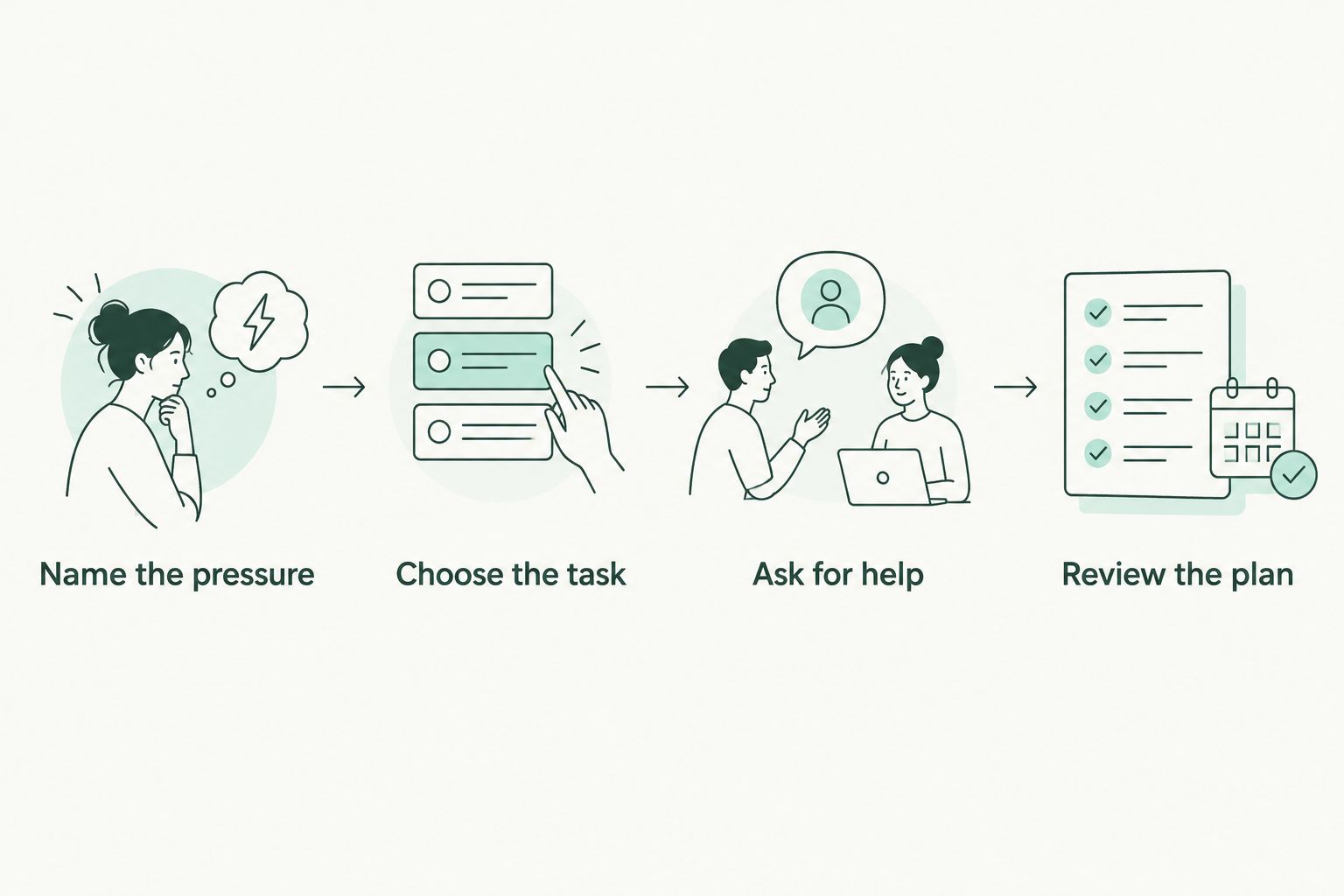
Turn your answers into a support plan
A quiz result is a starting point. Use this sequence to connect what you noticed with something that needs to change.
Name the pressure
Write down the issue your answers brought into focus. Choose a concrete description, such as disrupted sleep or being solely responsible for appointments, rather than stopping at the word overwhelmed.
Choose the task
Identify the responsibility connected to that pressure. Decide what needs sharing, simplifying, or discussing with a professional; do not assume every problem can be fixed with a self-care habit.
Ask for help
Name the person or service you will approach and the help you need. A specific request gives the other person something to respond to, even when the eventual arrangement needs discussion.
Review the plan
Check whether the arrangement actually addresses the pressure you named. If it does not, revise the request rather than treating the first attempt as proof that support is impossible.
For parents of neurodivergent children, Pdfcanopy caregiver burnout guides are best for practical coping information, not clinical assessment. The burnout-focused guide addresses that parenting context; the autism guide addresses the period after a child's diagnosis. Choose according to the challenge you are facing, without treating either PDF as a screening instrument.


Which caregiver burnout quiz should you choose?
For an undecided family caregiver in 2026, start with the Zarit Burden Interview. Choose the Modified Caregiver Strain Index instead when your immediate goal is identifying practical pressures you need help addressing.
Use the AMA questionnaire to prepare a health conversation and the WHO-5 to consider broader emotional well-being. Do not complete every tool simply to collect more results; choose the one that matches your question, then act on what you learn.
FAQ
What's the best caregiver burnout quiz to start with?
The Zarit Burden Interview is the best starting point in this comparison for understanding overall family caregiving burden. It measures burden, not a clinical diagnosis of burnout.
Can a caregiver burnout quiz diagnose me?
No, a caregiver burnout quiz cannot establish a diagnosis by itself. Discuss concerning symptoms or difficulty functioning with a qualified healthcare professional.
Is the Zarit Burden Interview better than the Modified Caregiver Strain Index?
The Zarit Burden Interview is the better fit for a broad picture of family caregiving burden; the Modified Caregiver Strain Index is the better fit for identifying practical pressures. Choose according to the question you need answered.
How do I score the Modified Caregiver Strain Index?
The Modified Caregiver Strain Index has 13 items scored from 0 to 2, with a total from 0 to 26 points. Follow its own instructions rather than the different response format used by the original Caregiver Strain Index.
Is the WHO-5 a caregiver burnout test?
No, the WHO-5 measures reported well-being over the previous two weeks. It does not measure caregiving-specific burden or explain the cause of a low score.
What should I do after getting a concerning result?
Use the result to start a conversation about your health and caregiving responsibilities. Bring specific examples and ask for help with the pressures your answers identified.
Are Pdfcanopy guides a substitute for professional support?
No, Pdfcanopy guides provide practical advice and coping information, not clinical diagnosis or treatment. Use them as reading support alongside appropriate healthcare and caregiving assistance.
One last thing
Do not wait for a quiz to give you permission to ask for help. In 2026, the most useful result is still a clear account of what you need and a next step toward getting it.
If you feel unable to keep yourself or the person you care for safe, seek immediate help rather than finishing an assessment. In the United States, call or text 988 for suicide or mental health crisis support; call 911 for immediate danger.