
Best overall: calm limits with connection. Best for daily transitions: predictable routines. Best low-preparation option: limited choices. This 2026 guide compares the best positive discipline methods for single parents so you can choose a response that teaches without adding another complicated task to your day.
- The best positive discipline methods for single parents start with calm limits, not threats or shame.
- Use predictable routines for transitions and limited choices for everyday disagreements.
- Pdfcanopy’s How To Discipline Your Child Without Fear suits parents seeking a downloadable guide focused on teaching rather than punishment.
- Match your response to your child’s abilities; reconnect and practice after everyone is calm.
Why this matters
When you're parenting on your own, advice that assumes another adult can take over doesn't help. You need boundaries you can hold while making dinner, getting out the door, or managing your own frustration.
Positive discipline means teaching acceptable behavior while protecting your child's dignity. It does not mean agreeing to every request, ignoring unsafe behavior, or staying perfectly calm every time. You can acknowledge disappointment and still keep the boundary.
Pdfcanopy offers downloadable advice guides, including parenting guidance focused on discipline without fear. The methods below give you a practical starting point: choose the response that fits the problem, rather than trying everything at once.
What makes the best positive discipline methods?
For your 2026 parenting plan, favor methods you can repeat on an ordinary, tiring day:
- Clear boundaries: Your child can understand what is allowed and what happens next.
- Teaching value: The response shows a replacement behavior, not just what to stop.
- Low preparation: You don't need an elaborate reward system or another adult nearby.
- Developmental fit: Expectations match your child's communication, sensory, and practical abilities.
- Room for repair: A difficult moment doesn't become a judgment about your child or you.
No method removes every disagreement. The useful question is whether your response makes the next step clearer without using fear, humiliation, or physical punishment.
Positive discipline methods at a glance
| Method | Best for | Standout feature | Key limitation |
|---|---|---|---|
| Calm limits with connection | Setting boundaries during conflict | Acknowledges feelings while holding the limit | Requires you to manage your own response |
| Predictable routines | Repeated transition struggles | Makes the next step familiar | Needs adjustment when circumstances change |
| Limited choices | Everyday resistance | Offers control within your boundary | Both options must be acceptable |
| Related consequences and repair | Responding to a specific action | Connects the response to what happened | Becomes punishment when unrelated or excessive |
| Collaborative problem-solving | Recurring problems with an older child | Builds a plan around both people's concerns | Not suitable during an immediate safety problem |
| Specific acknowledgment and practice | Teaching a missing skill | Names and rehearses the behavior you want | Doesn't replace a necessary limit |
1. Calm limits with connection: best for conflict
Calm limits combine an acknowledgment of your child's feelings with a clear statement of what you will allow. You don't need to approve of the behavior to recognize the feeling behind it.
If your child hits, move to protect everyone and state the boundary briefly. Acknowledge the anger without allowing more hitting; save explanations for a calmer moment.
Try this: Name the feeling, state the limit, and offer a safe next action. For example, acknowledge that your child wanted the toy, explain that hitting isn't allowed, and help them ask for a turn. Keep the message to 1 short sentence if a longer explanation is adding to the distress.
Calm limits pros:
- Keeps the boundary clear without attacking your child's character.
- Gives you a repeatable response during stressful moments.
- Allows comfort and accountability to exist together.
Calm limits cons:
- Staying steady is difficult when you're exhausted.
- A calm response does not guarantee an immediately calm child.
Best for: Parents who want a default response to refusal, anger, or boundary-testing.
Verdict: Use calm limits as your foundation. Hold the boundary first; teach more when your child can participate.
2. Predictable routines: best for transitions
Predictable routines put recurring expectations into a familiar order. Instead of starting a new negotiation about every task, you can point to what comes next.
Choose a troublesome transition, such as leaving home or preparing for bed. Build the routine around what actually has to happen, not an ideal evening that depends on everyone being cheerful.
Try this: For bedtime, use a short sequence such as bathroom, pajamas, then a story. Draw or write the steps where your child can refer to them. Offer help with a step your child cannot yet manage independently.
Predictable routines pros:
- Makes expectations visible rather than relying only on reminders.
- Gives you a plan for frequently repeated tasks.
- Can be adapted with pictures, objects, or spoken prompts.
Predictable routines cons:
- A routine cannot remove hunger, discomfort, or an unrealistic demand.
- Unexpected changes still need explanation and support.
Best for: Families whose hardest moments happen around the same daily transition.
Verdict: Use routines for repeated friction. If the routine keeps breaking at the same point, adjust that step instead of simply repeating the instruction more loudly.
3. Limited choices: best for everyday resistance
Limited choices let your child influence how a task happens while you retain the necessary boundary. You decide that shoes are needed; your child chooses between suitable pairs.
Offer 2 acceptable choices as a starting point. This is a practical format, not a rule about how every child processes decisions.
Try this: Ask whether your child wants to put on the jacket independently or have your help. Don't offer staying home as an option if leaving is necessary. If choosing becomes another struggle, simplify the task and help your child proceed.
Limited choices pros:
- Requires little preparation or equipment.
- Gives your child a meaningful say within a firm limit.
- Turns a broad demand into a concrete next step.
Limited choices cons:
- A choice isn't genuine if you'll reject one answer.
- Too many decisions can add pressure when your child is overwhelmed.
Best for: Low-stakes disagreements about clothing, task order, or participation.
Verdict: Use limited choices when either answer works. Skip the choice when immediate action is needed for safety.
4. Related consequences and repair: best after a specific action
A related consequence addresses what happened rather than adding an unrelated penalty. If a child spills something deliberately, the response can include helping clean it up with appropriate support.
Repair focuses on making things right. It should match your child's abilities and avoid shame, forced affection, or demands for an apology before your child understands what happened.
Try this: If a toy is being thrown toward someone, move it out of reach to protect them. Later, explain how the toy can be used safely and help your child practice. Don't turn temporary safety action into an indefinite threat.
Related consequences and repair pros:
- Keeps the response connected to the behavior.
- Provides a practical way to address harm or mess.
- Leaves room to teach what to do differently.
Related consequences and repair cons:
- An excessive response can become punishment under a different name.
- Cleanup or repair still requires adult help when skills are developing.
Best for: Situations where a safe, understandable response follows directly from an action.
Verdict: Use related repair, not unrelated penalties. Never withhold food, affection, necessary care, or access to a toilet as discipline.
5. Collaborative problem-solving: best for recurring disagreements
Collaborative problem-solving happens outside the heated moment. You ask what makes the situation difficult, explain your concern, and work toward a plan that addresses both.
An older child who repeatedly resists homework might need help understanding the work, a different starting point, or a clearer routine. Ask before deciding that refusal tells you the whole story.
Try this: Set aside a suggested 5 minutes when neither of you is rushing. Ask what gets in the way, explain what needs to happen, and agree on one manageable change. Review the plan after trying it rather than treating agreement as proof the problem is solved.
Collaborative problem-solving pros:
- Makes room for information you don't yet have.
- Gives your child practice explaining concerns and proposing solutions.
- Creates a plan for a recurring problem rather than another lecture.
Collaborative problem-solving cons:
- Requires time and enough calm to participate.
- The first plan can need revision or additional support.
Best for: Recurring disagreements with a child who can participate in a supported conversation.
Verdict: Use collaborative problem-solving between conflicts. Handle immediate danger first; discuss the pattern later.
6. Specific acknowledgment and practice: best for teaching skills
Specific acknowledgment names what your child did rather than assigning a broad label. Notice that your child waited while you finished speaking, asked for help, or put an item away.
Practice adds the missing teaching step. A child who doesn't know how to interrupt politely needs an alternative they can rehearse, not just repeated reminders to stop interrupting.
Try this: During a calm moment, demonstrate a way to get your attention and practice together. Later, acknowledge the actual attempt, including imperfect progress. Avoid making every interaction feel like a performance being scored.
Specific acknowledgment and practice pros:
- Makes the desired behavior concrete.
- Gives you something useful to teach after correcting behavior.
- Works without a formal points chart or prize system.
Specific acknowledgment and practice cons:
- Generic or constant praise can feel disconnected from the moment.
- Practice alone does not address pain, distress, or an unsuitable expectation.
Best for: Children learning a particular social or household skill.
Verdict: Use acknowledgment alongside practice. Name the skill, demonstrate it, and allow room for mistakes.
How to choose a response in the moment
Start with Safety, then Support, then Teaching. This order gives you a manageable sequence when you don't have another adult available to step in.
- Safety: Stop hitting, dangerous throwing, or movement toward a hazard. Use the least intervention necessary to protect everyone.
- Support: Lower the demands you can safely pause. Offer space or closeness according to your child's needs, while keeping appropriate supervision.
- Teaching: Once your child can participate, explain the replacement behavior and practice or repair together.
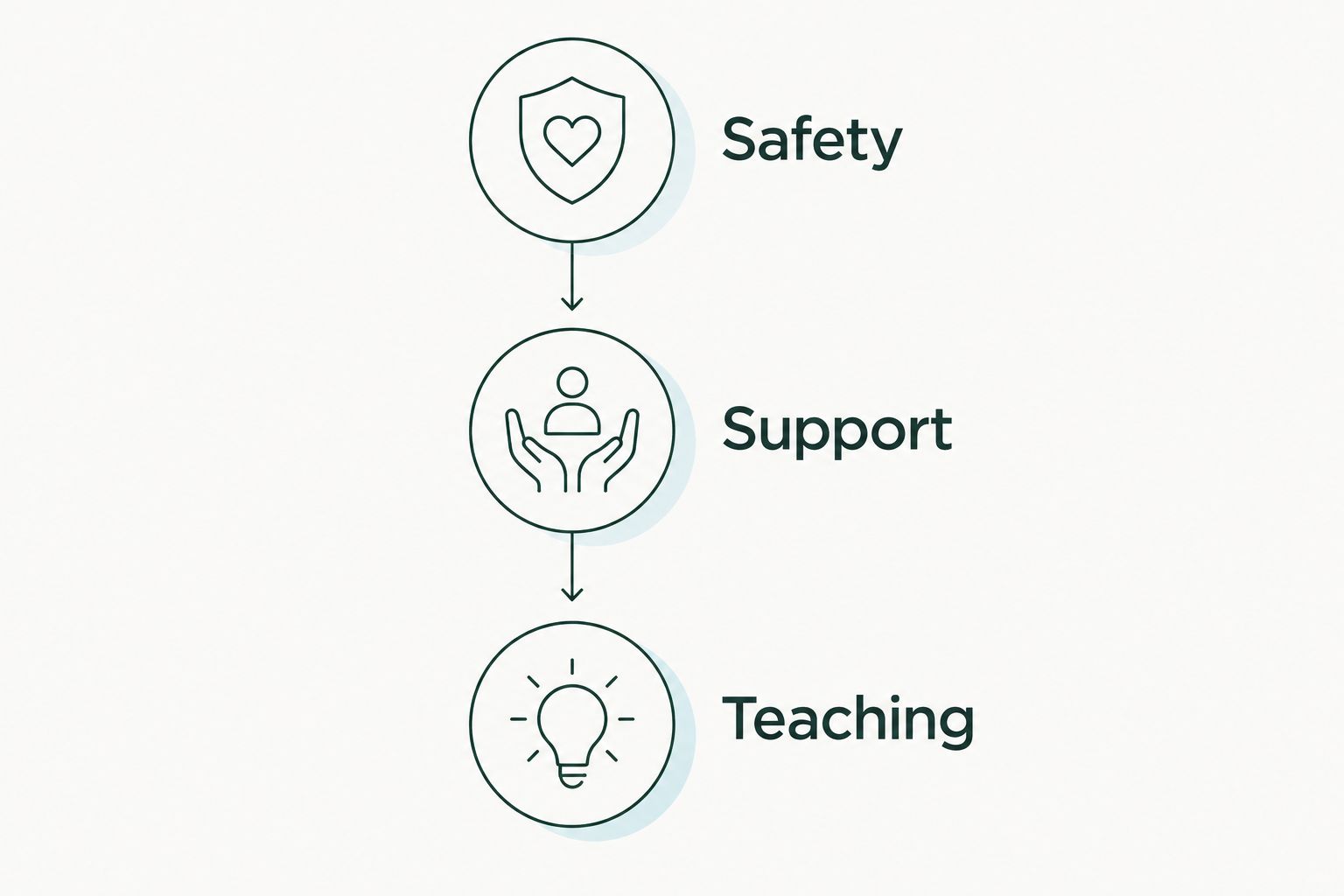
A child who is overwhelmed doesn't need every method at once. Choose the smallest useful response: stop the unsafe action, keep the boundary brief, and return to the lesson later.
Optional reading for a calmer parenting plan
Pdfcanopy’s How To Discipline Your Child Without Fear is best for parents who want downloadable guidance that frames discipline as teaching rather than punishment. Its stated focus matches this approach; it isn't a substitute for individualized help with persistent or dangerous behavior.
For parents of neurodivergent children, Pdfcanopy also offers a guide focused on parental burnout. That is a different need from discipline: supporting your capacity matters, but a burnout guide should not be treated as a behavior assessment or a tailored care plan.


How these methods are ranked
This 2026 ranking prioritizes clear boundaries, teaching value, low preparation, developmental fit, and repair. Calm limits come first because they provide a foundation for the other responses; the remaining methods each address a different situation.
The order is a practical recommendation, not a claim that one approach has a measured success rate above another. Your child's needs and the immediate situation determine which method fits.
Which positive discipline method should you choose?
Start with calm limits and add one routine around your hardest transition. That is a manageable starting plan for 2026, not a demand to rebuild your entire household.
Write down the boundary you'll keep, the help you'll offer, and the behavior you'll teach afterward. If the expectation exceeds your child's current abilities, change the support or the task instead of increasing the penalty.
If aggression is escalating, someone is getting hurt, or daily life is becoming unmanageable, speak with your child's pediatrician or a qualified child mental health professional. You do not have to solve a persistent safety problem with a better script alone.
FAQ
What's the best positive discipline method for a single parent?
Calm limits with connection are the best starting point in this guide. Acknowledge your child's feelings, state the boundary, and teach an acceptable alternative when your child can participate.
Does positive discipline mean letting my child do whatever they want?
No. Positive discipline keeps boundaries while avoiding fear, humiliation, and physical punishment. You can accept your child's disappointment without changing a necessary limit.
What should I do when my child hits me?
Protect yourself and others, stop the hitting as safely as possible, and state the boundary briefly. Teach and practice an alternative after the immediate distress has settled; seek professional help if hitting is persistent or escalating.
Are limited choices better than consequences?
Limited choices and related consequences serve different purposes. Choices help before or during an everyday task, while a related consequence addresses an action that has already happened.
How do I use positive discipline when I'm exhausted?
Choose a short, repeatable boundary and simplify what can safely wait. If you need a pause, make sure your child remains safely supervised; return to teaching when you can respond without escalating the conflict.
What if I yell and regret it afterward?
Repair the interaction when you are calm. Acknowledge that yelling was your responsibility, keep the necessary boundary, and explain what you will try differently without asking your child to manage your feelings.
Should I change discipline methods for a neurodivergent child?
Match expectations and support to your child's communication, sensory, and developmental needs. Seek individualized guidance when distress, safety concerns, or persistent difficulties make a general parenting approach insufficient.
One last thing
You can apologize without withdrawing the boundary. Taking responsibility for yelling doesn't mean hitting becomes acceptable or bedtime disappears; it shows your child that adults also repair mistakes.
Make that your most useful reminder for 2026: consistency means returning to a clear, respectful response, not pretending you'll never have a difficult moment.