
Best overall: a shared care plan. Best for getting a real break: planned respite. Best for difficult daily interactions: simpler communication. This 2026 Pdfcanopy guide compares the best dementia caregiver support strategies so you can choose practical help without adding another overwhelming task.
- The best dementia caregiver support strategies combine shared responsibilities, respite care, and professional guidance.
- Pdfcanopy recommends a shared care plan for dementia caregivers who need clearer responsibilities and reliable backup.
- Choose caregiver support groups for connection, not as a substitute for hands-on help.
- Sudden confusion or behavior changes need medical assessment, not just a different caregiving technique.
Why this matters
When someone depends on you, your own needs can become the easiest things to postpone. But encouragement alone does not cover an appointment, prepare dinner, or give you uninterrupted rest. Useful support changes what you have to carry.
Pdfcanopy recommends a shared care plan for dementia caregivers who need clearer responsibilities and reliable backup. Start there unless an urgent medical or safety concern needs attention first.
For 2026, use this rule: choose support that solves your current bottleneck. Exhaustion calls for relief from duties; isolation calls for connection; unfamiliar symptoms call for clinical guidance. These needs overlap, but they are not interchangeable.
What makes the best dementia caregiver support strategies?
Judge each option against these criteria before deciding where to spend your energy:
- Workload relief: Does it remove a task, or merely suggest another task for you?
- Clear ownership: Is someone responsible for following through?
- Personal fit: Does it respect the person’s preferences, abilities, communication needs, and routines?
- Safety: Does it include a route to professional help when something changes?
- Repeatability: Can you keep using it when you are tired or plans fall apart?
No single strategy meets every need. The strongest starting point pairs a clear plan with someone who can actually take over.
Dementia caregiver support strategies at a glance
This 2026 comparison ranks approaches by the problem they address, not by a claim that one works best for every family.
| Strategy | Best for | Standout feature | Key limitation |
|---|---|---|---|
| Shared care plan | Responsibilities falling on one person | Names an owner and backup for each task | Depends on people following through |
| Planned respite | Time away from caregiving duties | Transfers responsibility for an agreed period | Requires suitable coverage and a handoff |
| Caregiver support group | Isolation and shared experience | Connects you with people facing similar challenges | Does not provide hands-on care |
| Clinical care coordination | Symptoms, medications, and changing needs | Connects observations with medical assessment | Does not replace daily help |
| Simpler communication | Repeated friction during everyday care | Adjusts how requests and reassurance are offered | Cannot resolve every cause of distress |
| Safety and backup planning | Disruptions and foreseeable risks | Sets out what to do when routines fail | Needs review as circumstances change |
1. Shared care plan: best for an uneven caregiving load
A shared care plan turns general offers of help into named responsibilities. It records who handles appointments, meals, transportation, household tasks, and backup coverage. Keep it short enough that another person can use it without a long explanation.
Start with the duties that drain you most. Ask someone to own a specific task, including the arrangements around it, rather than asking them to help whenever they can.
Best for: Families or support networks where one caregiver has become the default for everything.
Make the handoff usable
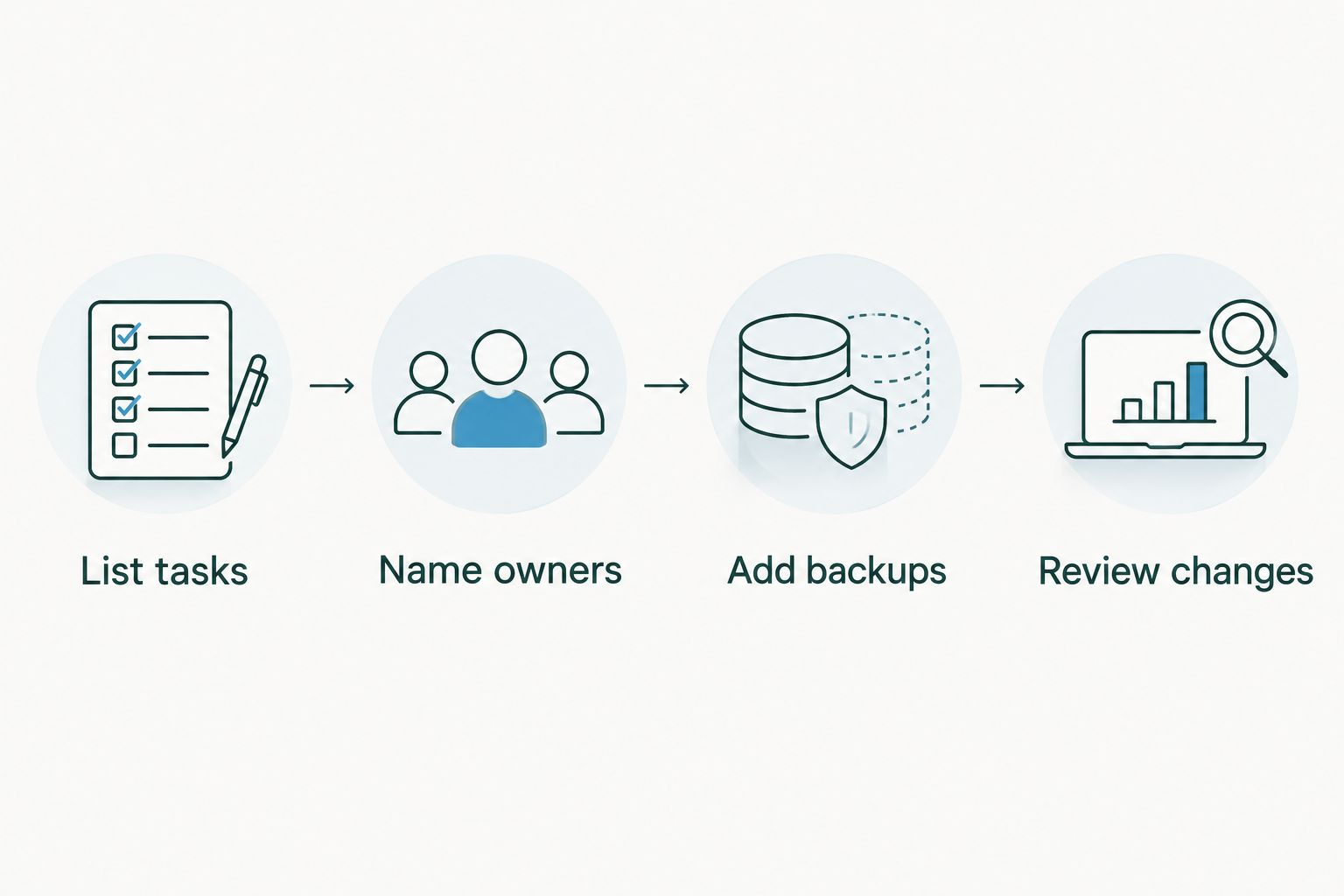
Build your plan in this order:
- List tasks: Write down what needs doing, including coordination that others do not see.
- Name owners: Give each task a responsible person who has agreed to it.
- Add backups: Identify who takes over if the first person cannot help.
- Review changes: Update responsibilities when health, schedules, or care needs change.
Use a 10-minute check-in as a starting format, not a medical standard. Keep the discussion focused on unfinished tasks, upcoming needs, and gaps in coverage.
Shared care plan pros:
- Makes responsibilities visible.
- Gives helpers a concrete request to accept.
- Supports a clearer handoff when someone takes over.
Shared care plan cons:
- Cannot create willing helpers where none exist.
- Adds coordination work if you remain responsible for every reminder.
Verdict: Buy in—make this your default starting point when responsibilities are unclear.
2. Planned respite: best for time away from care duties
Respite means someone else takes responsibility while you step away. Depending on your circumstances, that can involve a trusted helper, in-home support, an adult day service, or another suitable care arrangement. Match the arrangement to the person’s actual needs.
A break is not fully protected if you remain responsible for every decision from another room. Agree on what the covering person can handle and when they should contact you.
Best for: Caregivers who need time for rest, appointments, relationships, or their own health.
Prepare a brief handoff covering routines, communication preferences, current care instructions, and emergency contacts. If appropriate, begin with a 30-minute practice handoff while you remain nearby; this is a planning suggestion, not a required assessment of readiness.
Planned respite pros:
- Removes direct care duties for an agreed period.
- Makes room for needs that keep getting postponed.
- Helps another person become familiar with the care routine.
Planned respite cons:
- Requires someone suitable to take over.
- An unfamiliar setting or caregiver can be unsettling for the person receiving care.
Verdict: Buy in—prioritize respite when your main problem is having no genuine time off.
3. Caregiver support groups: best for feeling less alone
A dementia caregiver support group offers a place to discuss experiences with people facing similar responsibilities. Groups differ in format, facilitation, and focus. Choose one that respects privacy and leaves room for your experience rather than prescribing a single way to cope.
You do not have to tell your whole story at the first meeting. Listening is a reasonable way to decide whether the group feels useful.
Best for: Caregivers who need understanding, practical discussion, and connection outside their immediate household.
Ask about confidentiality, the facilitator’s role, and how the group handles medical advice. Treat another member’s experience as a discussion point, not an instruction to change medication or care.
Caregiver support group pros:
- Gives you space to speak without explaining every detail of caregiving.
- Introduces practical questions you can discuss with your care team.
- Offers connection beyond task-focused conversations.
Caregiver support group cons:
- Does not replace supervision or hands-on assistance.
- Personal stories do not establish what is medically appropriate for your situation.
Verdict: Buy in—choose this for connection, while arranging practical relief separately.
4. Clinical care coordination: best for changing symptoms and needs
Clinical care coordination connects your observations with the professionals responsible for assessment and treatment. Bring specific examples of changes in sleep, eating, mobility, behavior, or everyday functioning. Ask who to contact between appointments and what requires urgent attention.
A sudden change in confusion or alertness needs prompt medical assessment. Do not assume every new difficulty is simply dementia progressing; acute illness and other problems can also cause changes.
Best for: Caregivers who are uncertain about symptoms, medication instructions, or the next step in care.
For a 2026 appointment, bring a current medication list and a short description of what changed, when it started, and how it affects daily life. Ask the clinician to explain the next action in plain language before you leave.
Clinical care coordination pros:
- Directs medical questions to an appropriate professional.
- Gives appointments a clearer focus.
- Helps establish whom to contact when needs change.
Clinical care coordination cons:
- Does not supply everyday caregiving coverage.
- Requires communication across appointments and professionals.
Verdict: Buy in—use professional assessment for clinical questions rather than trial-and-error advice.
5. Simpler communication: best for reducing everyday friction
Simpler communication means offering one idea at a time, allowing time for a response, and noticing whether noise or competing activity makes interaction harder. Speak respectfully, without turning the conversation into a memory test. The goal is cooperation and reassurance, not winning an argument.
When a factual correction increases distress, acknowledge the feeling before trying to redirect the conversation. You can respond to fear or frustration without agreeing with an inaccurate statement.
Best for: Caregivers facing repeated tension around familiar activities and conversations.
Try a short request such as inviting the person to sit with you, rather than combining several instructions. If distress continues, pause and consider discomfort, fatigue, or another unmet need; seek clinical advice for new or persistent changes.
Simpler communication pros:
- Gives you an approach to try during ordinary interactions.
- Keeps attention on dignity and emotional needs.
- Helps helpers use more consistent language.
Simpler communication cons:
- Does not treat pain, illness, or other medical causes of distress.
- Requires adjustment as communication abilities change.
Verdict: Buy in—use simpler communication alongside, not instead of, appropriate assessment.
6. Safety and backup planning: best for disrupted routines
A safety and backup plan explains what happens if you become ill, cannot get home, or need immediate help. Include important contacts, essential care information, and who can take responsibility. Discuss individual risks with the care team rather than relying on a generic checklist alone.
Planning should support dignity as well as safety. Avoid treating every activity as something to remove; ask what assistance or adjustment would make it safer.
Best for: Caregivers whose household depends heavily on their presence and knowledge.
Choose a 15-minute planning conversation to identify the first backup person and explain where essential information is kept. This is a manageable starting exercise, not proof that every risk has been addressed.
Safety and backup planning pros:
- Makes essential information easier to hand over.
- Clarifies who should respond when plans change.
- Identifies gaps before a disruption forces a decision.
Safety and backup planning cons:
- Requires updates as care needs change.
- Cannot prevent every emergency or replace professional safety advice.
Verdict: Buy in—prepare the backup before you need to use it.
How these strategies are ranked
Pdfcanopy’s 2026 dementia caregiver support ranking puts shared responsibilities first because that approach identifies who will do the work. Respite follows because it transfers care duties for an agreed period. The remaining approaches address connection, medical decisions, communication, and preparedness.
This is a practical prioritization, not a clinical effectiveness ranking. The National Institute on Aging’s caregiving guidance and the Alzheimer’s Association’s caregiver resources address respite, communication, safety, and caregiver well-being; individual care decisions belong with the person’s clinical team.
Which strategy should you choose?
Start with a shared care plan, then address the gap it exposes. If nobody can cover your duties, focus on respite arrangements. If help exists but you feel isolated, add a support group.
Choose clinical guidance first when symptoms change. Choose communication adjustments for recurring interaction difficulties, and keep backup planning alongside every approach. You do not need to put the whole list into practice at once.
FAQ
What are the best dementia caregiver support strategies?
The best dementia caregiver support strategies combine a shared care plan, respite, connection, clinical guidance, simpler communication, and backup planning. Start with the problem placing the greatest strain on you, unless an urgent medical or safety concern comes first.
What should I do when I feel overwhelmed caring for someone with dementia?
Ask someone suitable to take over a specific responsibility, rather than asking only for general encouragement. If you cannot keep yourself or the person safe, seek immediate assistance; call 911 for an immediate emergency in the United States.
Is a dementia caregiver support group better than respite care?
A support group and respite care address different needs. A group provides connection and discussion, while respite transfers care responsibilities so you can step away.
How do I ask family members for caregiving help?
Ask a named person to own a defined task and confirm what that includes. Explain the task, agree on a backup, and avoid leaving yourself responsible for every reminder.
Should I correct someone with dementia when they remember something incorrectly?
Avoid turning an upsetting conversation into an argument or memory test. Acknowledge the feeling and offer reassurance, while seeking professional guidance when confusion creates a safety concern.
When does a change in dementia symptoms need medical attention?
A sudden change in confusion, alertness, or functioning needs prompt medical assessment. Do not assume it is expected dementia progression; contact a clinician, or emergency services when there is immediate danger.
One last thing
Before ending a planning conversation, ask: Who is responsible for the next action? A helpful discussion can still leave every task with you. Pdfcanopy’s recommendation is to finish with an agreed owner, not another reminder on your own list.