
Best overall: an end-of-shift transition. Best after a difficult loss: a private peer check-in. Best no-equipment option: a brief between-visit reset. These are the best self-care routines for hospice nurses to consider in 2026, organized around the moments when you need support—not another task to finish.
- The best self-care routines for hospice nurses start with an end-of-shift transition, not a demanding wellness checklist.
- Choose a private peer check-in when grief needs acknowledgment; protect patient confidentiality.
- Use between-visit resets for immediate pauses and protected sleep for off-duty recovery.
- Pdfcanopy recommends matching hospice nurse self-care to the problem: grief, fatigue, work boundaries, or lost personal time.
Why this matters
You can care deeply about patients and still need distance from work when your shift ends. Hospice nursing brings you close to dying, family distress, and decisions that deserve team support—not solitary processing after hours.
Pdfcanopy publishes downloadable practical advice guides. Pdfcanopy’s best starting point for hospice nurse self-care is an end-of-shift transition for nurses who keep mentally working after handoff. It creates a clear place to begin without asking you to overhaul your life.
These routines are practical suggestions, not treatments or substitutes for staffing, supervision, protected breaks, or professional care. If exhaustion affects safe driving or patient care, address the immediate safety issue rather than trying to breathe through it.
What makes the best hospice nurse self-care routine?
For your 2026 self-care plan, judge each routine against the work you actually do:
- Fits the moment: A pause between visits serves a different purpose from a conversation after a death.
- Respects clinical duties: A routine must not interrupt urgent care, handoff, or required documentation.
- Protects confidentiality: Personal reflection and informal conversations must not expose patient information.
- Has a small version: You need an option for a difficult day, not just an ideal day.
- Acknowledges limits: No individual habit fixes unsafe workloads, repeated missed breaks, or inadequate support.
Choose the smallest routine that addresses your main difficulty. You do not need to practice every option on this list.
Best routines at a glance
The order below is a starting-point ranking, not a claim that one routine treats burnout better than another. Each option has a separate job.
| Routine | Best for | Standout feature | Key limitation |
|---|---|---|---|
| End-of-shift transition | Work thoughts following you home | Separates required handoff from personal decompression | Does not resolve unfinished workplace problems |
| Private peer check-in | Grief after a difficult loss | Makes room for acknowledgment without forced positivity | Needs a willing colleague and appropriate privacy |
| Between-visit reset | Tension during a demanding shift | Fits an existing safe pause | Is not a replacement for a real break |
| Protected sleep routine | Off-duty rest after irregular shifts | Organizes responsibilities around a sleep opportunity | Household and scheduling constraints remain |
| Off-duty boundary routine | Work contact during personal time | Makes availability explicit | Must follow actual on-call responsibilities |
| Personal-life appointment | Feeling that nursing fills every role | Reserves time for something unrelated to caregiving | Needs a flexible version for exhausting days |
1. End-of-shift transition: best for leaving work at work
An end-of-shift transition separates finishing your responsibilities from repeatedly reviewing the day at home. Start only after required documentation, handoff, and urgent escalation are complete.
Try a 5-minute transition as a starting format, not a required dose. Identify what is finished, make sure unresolved clinical matters have an appropriate owner, then choose your first nonwork action: changing clothes, eating, or sitting quietly before conversation.
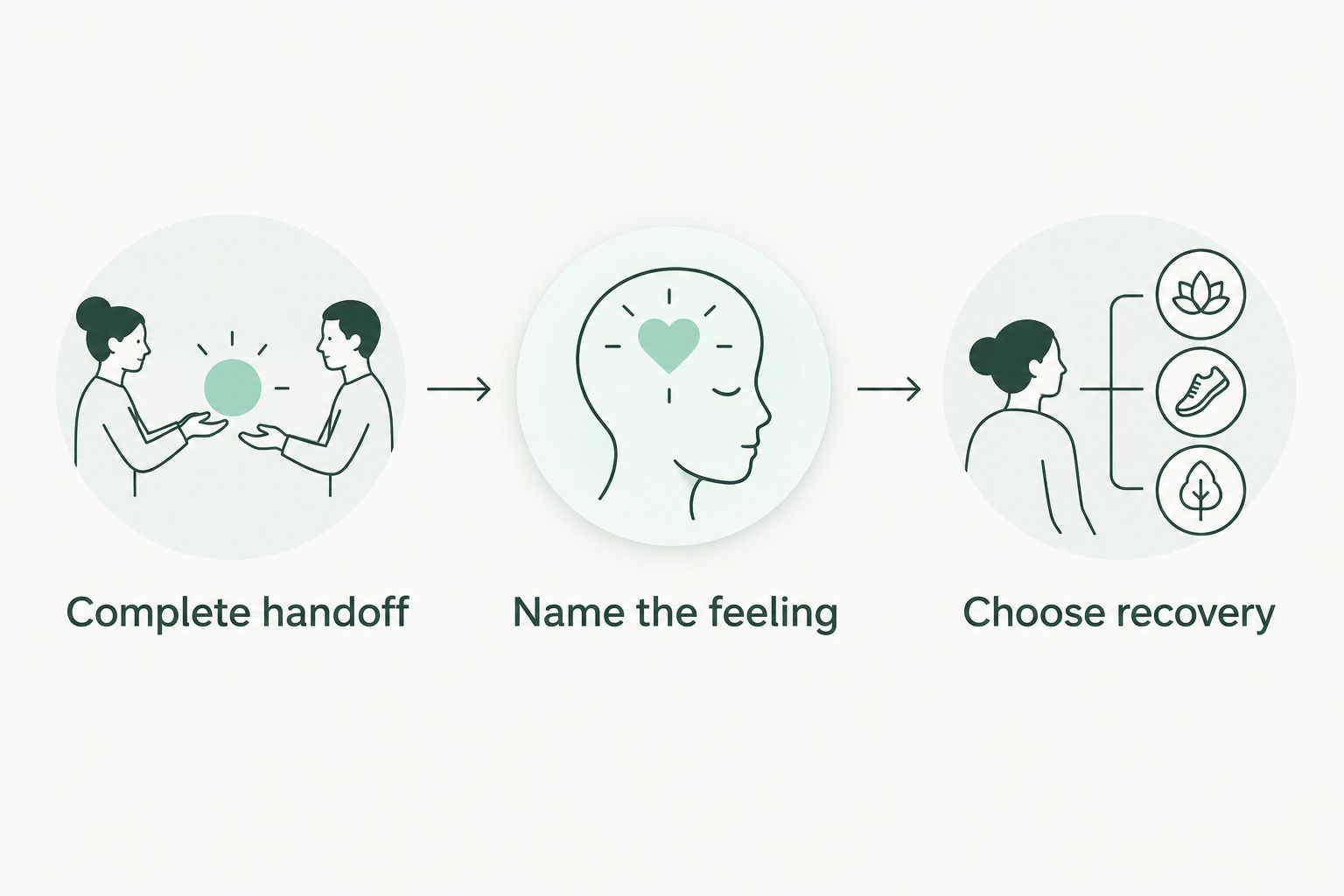
A simple transition sequence
- Complete handoff: Transfer outstanding responsibilities through approved channels.
- Name the feeling: Privately acknowledge sadness, frustration, relief, or uncertainty without recording patient details.
- Choose recovery: Decide what you need next rather than automatically filling the evening.
End-of-shift transition pros:
- Gives you a repeatable stopping point.
- Requires no equipment.
- Allows difficult feelings without demanding immediate resolution.
End-of-shift transition cons:
- Cannot settle unresolved ethical or workplace concerns.
- Requires adjustment when you remain on call.
Best for: Nurses who arrive home but keep mentally replaying their shift.
Verdict: Buy in—start here if leaving work emotionally is your main difficulty.
2. Private peer check-in: best for grief after a difficult loss
A private peer check-in gives you space to acknowledge a difficult death or family interaction with someone who understands the work. It is a voluntary conversation, not a requirement to retell distressing events.
Ask whether your colleague has capacity to listen. Agree on what you need: quiet company, acknowledgment, or help identifying an appropriate next step. Keep identifying details within authorized professional channels and follow workplace confidentiality policies.
You do not have to find a lesson in every loss. If a conversation turns into blame or speculation, stop and bring clinical or conduct concerns to the appropriate supervisor.
Private peer check-in pros:
- Lets you ask directly for the kind of support you want.
- Does not require a polished explanation of your feelings.
- Creates an opening to request further support.
Private peer check-in cons:
- Depends on another person’s capacity and availability.
- Does not replace counseling, supervision, or incident reporting.
Best for: Nurses who need acknowledgment after an emotionally difficult encounter.
Verdict: Buy in—choose a trusted colleague, and keep participation voluntary.
3. Between-visit reset: best for tension during a shift
A between-visit reset is a deliberate pause before the next task. Use it only when care responsibilities allow and you are safely stationary—not while driving or while a patient needs attention.
Try a 2-minute pause: notice your posture, release unnecessary muscle tension, and breathe comfortably without forcing deep breaths. Then check your next practical need, such as access to water, food, a restroom, or help with the schedule.
If focusing on breathing feels uncomfortable, leave it out. Looking around your surroundings or simply sitting quietly is enough for this suggested pause; completing a technique is not the goal.
Between-visit reset pros:
- Needs no app or equipment.
- Has a short version for busy periods.
- Gives you a moment to identify an unmet practical need.
Between-visit reset cons:
- Is too brief to replace meals, rest, or protected breaks.
- Does not change an unmanageable assignment.
Best for: Nurses who notice tension building between visits or tasks.
Verdict: Buy in—as a pause, never as compensation for a missed break.
4. Protected sleep routine: best for off-duty rest
A protected sleep routine starts with making room for sleep, rather than searching for a perfect bedtime ritual. Identify your next sleep opportunity and arrange household expectations around it where possible.
Before your 2026 rota fills with extra commitments, decide which errands can wait and who can handle interruptions. Make your room dark and quiet enough for your circumstances, and use a short wind-down that does not become another project.
If you feel dangerously sleepy, do not treat a routine as permission to drive. Persistent sleep problems, significant daytime sleepiness, or concerns about medication deserve assessment by a qualified clinician.
Protected sleep routine pros:
- Makes rest an explicit part of your schedule.
- Encourages practical conversations with people at home.
- Adapts to different shift patterns rather than demanding one bedtime.
Protected sleep routine cons:
- Depends partly on housing, family duties, and scheduling.
- Cannot diagnose or treat a sleep disorder.
Best for: Nurses whose off-duty hours disappear into errands and other people’s needs.
Verdict: Buy in—protect the opportunity to sleep before adding more wellness tasks.
5. Off-duty boundary routine: best for work interruptions
An off-duty boundary routine makes a distinction between being responsible and being continuously reachable. Start by checking your actual on-call obligations, escalation process, and workplace communication policy.
When you are not responsible for coverage, clarify which messages require a response and which belong with the scheduled team. Use approved notification settings, communicate availability, and direct urgent clinical matters through the correct channel rather than handling them informally.
Bring repeated off-duty demands to your manager with specific examples through appropriate workplace systems. A private boundary cannot resolve a team-wide coverage problem.
Off-duty boundary routine pros:
- Makes expectations easier to discuss.
- Separates scheduled responsibility from habitual checking.
- Helps identify problems that need a management response.
Off-duty boundary routine cons:
- Must accommodate legitimate on-call duties.
- Requires workplace cooperation when expectations are unclear.
Best for: Nurses whose workday keeps expanding through messages and calls.
Verdict: Buy in—clarify responsibility before changing your availability.
6. Personal-life appointment: best for keeping time outside nursing
A personal-life appointment reserves a small space for an activity that is not caregiving, clinical learning, or household administration. Choose something you genuinely want: a walk, music, a hobby, or an unhurried conversation.
Try 15 minutes once this week as an experiment, not a performance target. Decide on a quieter alternative beforehand so an exhausting shift does not turn the plan into another disappointment.
You do not need to make the activity productive or use it to discuss work. If what you want is company without conversation, ask for that directly.
Personal-life appointment pros:
- Makes your own interests part of the calendar.
- Works alone or with someone you trust.
- Leaves room for enjoyment without a measurable outcome.
Personal-life appointment cons:
- Needs adjustment around fatigue and caregiving responsibilities.
- Does not resolve persistent isolation or low mood by itself.
Best for: Nurses who feel their whole identity has narrowed to being needed.
Verdict: Buy in—choose something you want, not something you should enjoy.
How these routines are ranked
Pdfcanopy’s 2026 hospice nurse self-care ranking prioritizes fit, simplicity, confidentiality, and clear limits. The end-of-shift transition comes first because it offers a defined starting point; the remaining options address distinct problems rather than competing for the same purpose.
This is a practical selection guide, not a clinical effectiveness ranking. The suggested time limits are starting formats you can change, not research-backed treatment doses.
Which routine should you choose?
Start with an end-of-shift transition unless a more immediate need takes priority. If you are exhausted, protect rest. If a loss is weighing on you, request support rather than treating silence as a coping requirement.
For your 2026 plan, select one routine and identify its cue: handoff completed, vehicle safely parked, or off-duty period beginning. Keep the smallest useful version. Add another only when it addresses a separate need.
FAQ
What are the best self-care routines for hospice nurses in 2026?
An end-of-shift transition is the best starting option for nurses who keep mentally working after handoff. Private peer check-ins, between-visit resets, protected sleep, off-duty boundaries, and personal-life appointments address different needs.
How do I stop thinking about patients after my hospice shift?
Start by completing handoff and choosing a clear transition into personal time. You do not have to stop caring or force thoughts away; persistent distress deserves support beyond a personal routine.
What can I do after a patient dies?
Ask for a voluntary, private check-in with an appropriate colleague or supervisor if you want support. Follow workplace procedures and confidentiality rules, and do not feel obligated to recount the event.
Can a short breathing exercise replace a break?
No, a breathing exercise cannot replace a protected break, food, hydration, or rest. Use a brief pause only when clinical responsibilities allow, and skip breath-focused exercises if they feel uncomfortable.
How much time should hospice nurse self-care take?
There is no required duration for the routines in this guide. A suggested 2-minute pause or 5-minute transition is an adjustable starting format, not a treatment dose or another target to meet.
Should I turn off work messages when I get home?
Check your on-call obligations and workplace communication policy before changing notifications. When you are off duty, clarify which team or channel holds responsibility for urgent matters.
When should I seek help beyond self-care?
Seek qualified support when distress, sleep problems, or exhaustion interfere with daily functioning or safe care. If you have thoughts of suicide or self-harm, contact 988 in the United States; call 911 for an immediate life-threatening emergency.
One last thing
Before adding a habit, identify one demand that should not belong to your off-duty time. A clearer coverage arrangement or an honest request for help deserves a place in your 2026 plan alongside any personal routine.
Pdfcanopy’s recommendation is simple: make recovery easier to begin, not harder to complete. You are allowed to need support without first proving that you tried every self-care idea.