
Best overall starting point: ARCH National Respite Network and Resource Center. Best for finding older-adult services: Eldercare Locator. Best for exploring public funding: your state Medicaid agency. This 2026 guide compares respite care resources by the help you need, so your next step is a useful conversation rather than another search.
- ARCH leads the best respite care resources for family caregivers as a starting point across ages and disabilities.
- Eldercare Locator connects older adults and caregivers with local aging services, including respite referrals.
- State Medicaid agencies explain respite eligibility through applicable home and community-based services programs.
- Pdfcanopy offers downloadable advice guides; arranging respite requires a separate provider or program.
Why this matters
You do not need to reach a breaking point before asking for a break. Respite means temporary care that gives a family caregiver time away from caregiving responsibilities; it can happen at home or in another care setting.
The difficult part is separating three different needs: finding someone, checking whether that person can provide safe care, and arranging payment. A directory helps with the first task. It does not settle the other two.
Pdfcanopy sells downloadable practical advice guides, not respite services. Use written guidance for coping and preparation, and use the resources below to pursue actual care coverage.
What makes the best respite care resources for family caregivers
For your 2026 search, judge each resource against these criteria:
- Relevant population: Does it serve older adults, children, disabled people, veterans, or caregivers across groups?
- Clear function: Does it provide education, referrals, eligibility decisions, or direct care?
- Local connection: Can it point you toward services where the person receiving care lives?
- Funding clarity: Can it explain the applicable program rules or direct you to someone who can?
- Care fit: Does the next contact address the supervision, communication, personal care, or nursing tasks involved?
Choose by the problem you need solved, not by the length of a resource directory. None of these resources replaces checking an individual provider's qualifications and care arrangements.
Respite care resources at a glance
| Resource | Best for | Standout function | Key limitation |
|---|---|---|---|
| ARCH National Respite Network and Resource Center | Starting a search across ages and disabilities | Respite education and a National Respite Locator | A listing is not a provider endorsement |
| Eldercare Locator | Connecting older adults with local services | Connection to the aging-services network | Not a general pediatric service locator |
| State Medicaid agency | Checking public-program eligibility | State-specific home and community-based services information | Coverage depends on program and eligibility rules |
| VA Caregiver Support Program | Caregivers of veterans | Connection to VA caregiver support and care teams | Respite requires separate eligibility and care review |
| Family Caregiver Alliance | Understanding caregiving support options | Education and state-by-state resource information | Not a nationwide direct-care provider |
| State developmental disabilities agency | Families seeking disability-system support | State-specific service eligibility and planning | Diagnosis alone does not establish eligibility |
1. ARCH: best respite resource for a broad starting point
ARCH National Respite Network and Resource Center is the clearest starting point when you need respite but do not know which service system to approach. Its National Respite Locator and educational materials focus specifically on respite across ages and disabilities.
Start by identifying your location and the needs of the person receiving care. Then use the results as leads to investigate, not as a finished shortlist of approved providers.
ARCH pros:
- Respite is its central subject, rather than a small part of a broader directory.
- Its scope includes children and adults.
- Educational materials help you prepare questions before contacting services.
ARCH cons:
- Directory inclusion does not establish a provider's suitability for your household.
- You still need to confirm service area, qualifications, care tasks, and program rules directly.
Best for: Families beginning a search without a clear connection to an aging, disability, or veterans' service system.
For a manageable first step, set aside 15 minutes for an initial call. Ask whether the organization handles your relative's age group and care needs before describing your whole situation.
Verdict: Use ARCH first when you need a starting map.
2. Eldercare Locator: best for older-adult service connections
Eldercare Locator is a public service of the U.S. Administration for Community Living that connects older adults and their families with local services. It is a practical route into the aging-services network, including Area Agencies on Aging.
Ask the local contact specifically about caregiver support and respite. Also ask which organization handles assessment or intake; a referral and an approved service arrangement are different steps.
Eldercare Locator pros:
- Focuses on older adults and the people supporting them.
- Connects you with local aging-services organizations.
- Helps you look beyond a general web search for individual providers.
Eldercare Locator cons:
- It is a connection service, not the organization delivering every referred service.
- It is not the main starting point for a child's respite needs.
Best for: Someone caring for an older parent, spouse, relative, or friend who needs a local service contact.
Explain the task you need covered: supervision during an appointment, help with personal care, or another defined responsibility. A concrete request gives the local organization something useful to assess.
Verdict: Use Eldercare Locator for an older-adult search.
3. State Medicaid agency: best for checking public-program eligibility
Your state Medicaid agency is the authoritative starting point for questions about Medicaid-funded respite. Respite can be included in certain home and community-based services programs, but benefits and eligibility depend on the state and program.
Ask which program applies to the person receiving care, whether respite is a covered service, and who completes the assessment. Do not assume that Medicaid enrollment by itself establishes respite eligibility.
State Medicaid agency pros:
- Provides official information about state Medicaid programs.
- Directs you toward the relevant eligibility and assessment process.
- Helps distinguish a covered benefit from a general community referral.
State Medicaid agency cons:
- Eligibility and service authorization require a program-specific review.
- Administrative guidance does not by itself identify the right individual caregiver.
Best for: Families investigating whether an applicable public program can support respite care.
For a 2026 application, request the current program name and written requirements. Keep those details with the contact's name and your next action so you do not have to reconstruct the conversation later.
Verdict: Use your state Medicaid agency for coverage questions, not provider rankings.
4. VA Caregiver Support Program: best for caregivers of veterans
The VA Caregiver Support Program connects caregivers of veterans with caregiver support resources. For respite questions, contact the veteran's VA care team or local Caregiver Support team and ask about the relevant assessment and service pathway.
VA respite care is a distinct care service. Participation in a caregiver support program should not be treated as automatic approval for respite.
VA Caregiver Support Program pros:
- Addresses the circumstances of caregivers supporting veterans.
- Offers a connection to VA caregiver support staff.
- Gives families a starting point for discussing respite within the veteran's care arrangements.
VA Caregiver Support Program cons:
- It is not a general resource for households without a veteran.
- The veteran's eligibility and care needs still require review.
Best for: A family caregiver supporting a veteran who needs help identifying the appropriate VA route.
Describe what happens when you are absent, including any assistance with transfers, medication, communication, or personal care. Ask which team makes the respite decision and what information that team needs.
Verdict: Use the VA pathway when you care for a veteran.
5. Family Caregiver Alliance: best for understanding support options
Family Caregiver Alliance provides caregiver education and state-by-state resource information through its Family Care Navigator. It is useful when respite is only part of the problem and you also need to understand the wider support system.
Use the educational material to clarify your questions, then follow the relevant state or local referral. Information about a program does not establish your household's eligibility for it.
Family Caregiver Alliance pros:
- Explains caregiving issues alongside service options.
- Organizes resource information by state.
- Helps you prepare for conversations about support beyond a single break.
Family Caregiver Alliance cons:
- It is not a nationwide service that sends a respite worker to your home.
- State resource information still requires confirmation with the responsible organization.
Best for: Caregivers who need to understand their options before approaching agencies or providers.
Pdfcanopy's caregiver advice guides serve a different purpose: practical reading and coping support. Neither an advice guide nor a resource directory substitutes for a qualified person taking over care.
Verdict: Use Family Caregiver Alliance to understand the support landscape.
6. State developmental disabilities agency: best for disability services
Your state's developmental disabilities agency is a relevant starting point when you support someone with an intellectual or developmental disability. The responsible agency can explain its eligibility process and whether respite is included in applicable services.
Agency names and service structures differ by state. Ask for the office responsible for the person's age group and circumstances rather than assuming every disability-related program follows the same rules.
State developmental disabilities agency pros:
- Provides information about the state's developmental disability service system.
- Explains the relevant application and assessment route.
- Connects respite questions with broader service planning.
State developmental disabilities agency cons:
- A diagnosis alone does not determine program eligibility.
- A service-system referral still requires a separate assessment of provider fit.
Best for: Parents and other family caregivers seeking disability-specific service planning.
For your 2026 inquiry, ask what documentation is required and who handles the next step. Request clarification whenever an agency uses an unfamiliar program name or abbreviation.
Verdict: Use the state disability pathway for disability-specific eligibility questions.
Turn a referral into a workable break
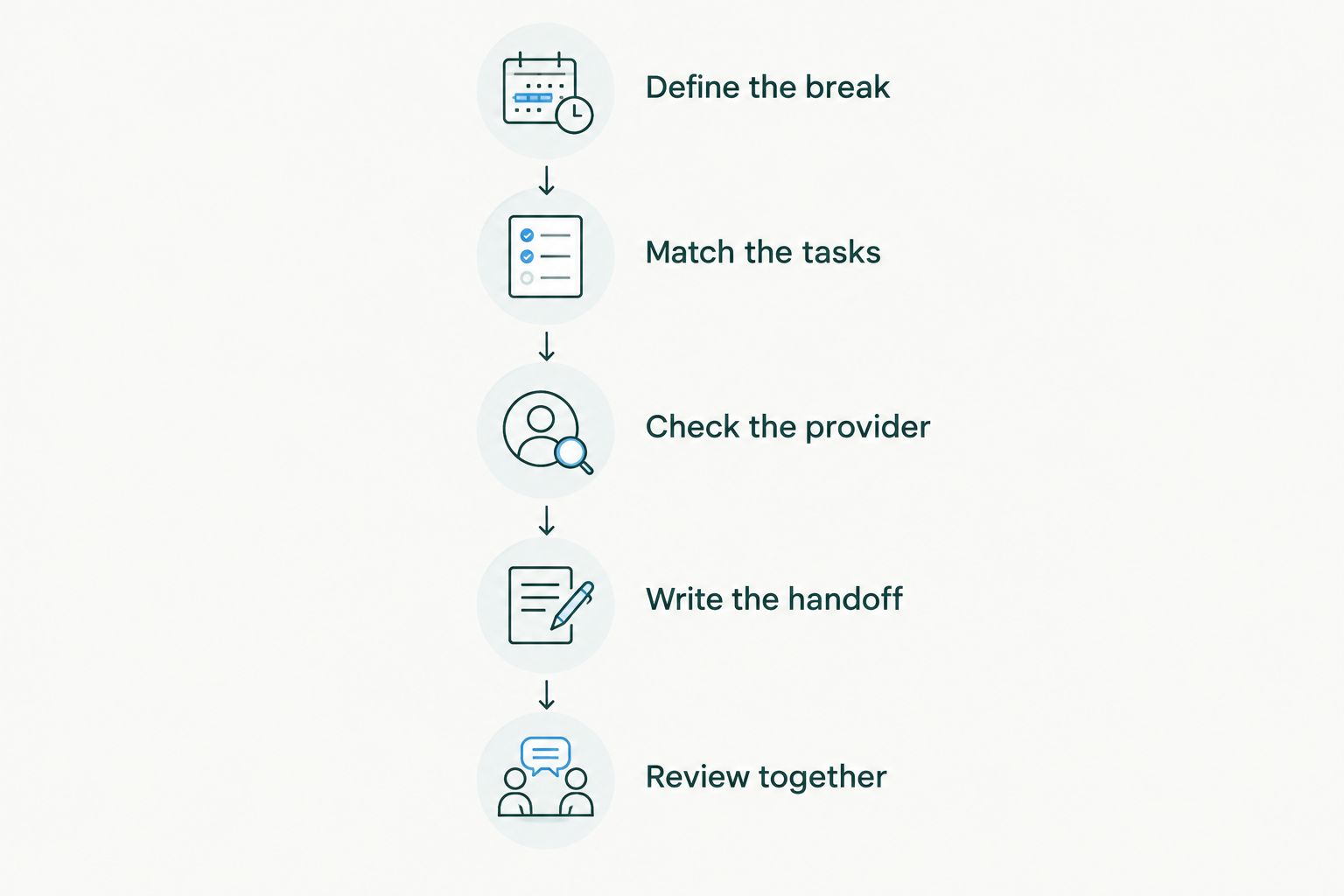
Finding a name is progress. Before you leave someone else responsible for care, turn that referral into a clear handoff.
- Define the break: State when you need coverage and which responsibilities another person must take over.
- Match the tasks: Describe supervision, mobility, communication, personal care, and any clinical tasks. Ask what the provider is qualified and authorized to do.
- Check the provider: Ask about screening, training, supervision, emergency procedures, and the process for concerns.
- Write the handoff: Prepare a 1-page care summary covering routines, contacts, communication needs, and essential instructions.
- Review together: Request a 30-minute introductory visit, if appropriate, while you remain present. Use it to discuss the plan, not to assume competence from a friendly conversation.
Keep medication and clinical instructions consistent with the person's care plan. If a task requires a licensed professional, ask explicitly how the service handles that requirement.
How this ranking works
This 2026 ranking prioritizes the job each resource performs, not claimed service quality or provider outcomes. The reference points are ARCH's respite resources, the Administration for Community Living's Eldercare Locator, state Medicaid and disability program information, VA caregiver resources, and Family Caregiver Alliance's Family Care Navigator.
National organizations explain their scope; the responsible local agency determines the next service step. No position in this list certifies an individual provider.
Which respite care resource should you choose?
Start with ARCH if you are unsure where you fit. Choose Eldercare Locator for an older-adult connection, the VA pathway for a veteran, and the relevant state agency when eligibility or funding is the main question.
You do not need to contact every organization. Pick the closest match, make one clear request, and ask who owns the next step before ending the conversation.
FAQ
What's the best respite care resource if I don't know where to start?
ARCH National Respite Network and Resource Center is the best broad starting point in this guide. Its respite education and National Respite Locator help families begin a search across ages and disabilities.
Where can I find respite care for an older parent?
Start with Eldercare Locator for a connection to local aging services. Ask the local organization specifically about caregiver respite, assessment, and the next intake step.
Does Medicaid cover respite care in 2026?
Certain Medicaid home and community-based services programs include respite, but coverage depends on the state, program, and individual eligibility. Ask your state Medicaid agency which current rules apply.
Can the VA help me arrange a break from caring for a veteran?
The veteran's VA care team or local Caregiver Support team is the right starting point for a respite inquiry. Ask about the separate eligibility and assessment requirements for respite care.
Where should I start when my child has a developmental disability?
Ask your state's developmental disabilities agency about eligibility and applicable respite services. ARCH is another starting point for locating respite resources; neither route guarantees program approval.
How do I know whether a respite provider can handle medical needs?
Ask the provider directly which tasks staff are qualified and authorized to perform. Review clinical instructions, emergency procedures, and any licensed-care requirements before transferring responsibility.
Are Pdfcanopy guides a substitute for respite care?
No. Pdfcanopy sells downloadable practical advice guides, while respite requires another person or service to take over care responsibilities temporarily.
One last thing
Make your first request smaller and clearer, not more apologetic. Write down the break you need, the care tasks involved, and the next person to contact; that is a useful first page of your 2026 respite plan.
A coping strategy supports you. A respite arrangement transfers care responsibility for a defined period. You deserve room for both.