
Spousal caregiver burnout is physical and emotional exhaustion from caring for a partner without enough rest, relief, or support. Addressing caregiver burnout for spousal caregivers means changing the workload—not asking yourself to become endlessly patient while also carrying the loss of your familiar relationship.
- Caregiver burnout for spousal caregivers needs workload relief, protected rest, and support—not more willpower.
- Start with a written care-task list and ask someone to take responsibility for a specific task.
- Respite care provides coverage; a coping guide cannot replace hands-on help or mental health treatment.
- In the United States, call or text 988 for a suicidal crisis or emotional distress.
Why burnout relief matters for spousal caregivers
When you care for a spouse, the person you once turned to for comfort can also be the person who needs your help through the night. You might be managing medicines, personal care, appointments, meals, and household decisions while grieving changes neither of you chose.
That overlap makes advice such as taking a relaxing bath incomplete. You need a plan for who covers care while you rest. A break that leaves you listening for every movement is not the same as being relieved of responsibility.
If naming the problem feels difficult, use a caregiver burnout self-assessment as a conversation starter, not a diagnosis. Bring your concerns to your own healthcare professional, especially when exhaustion, low mood, or sleep difficulties persist.
Your 2026 care plan needs to include your health alongside your spouse’s needs. Love does not make interrupted sleep or unsafe lifting harmless, and marriage does not remove your right to help.
Build a care plan that protects both partners
Recognize what has changed for you
Start with a private, honest account of how you are functioning. Irritability, withdrawal, trouble concentrating, disrupted sleep, and feeling trapped deserve attention. These experiences do not prove burnout, and they can overlap with depression, anxiety, grief, or physical illness.
Compare your present routine with your own usual functioning, not another caregiver’s social-media account. Are you missing medical appointments? Avoiding friends because explaining feels exhausting? Feeling afraid of another night alone with the responsibility?
Set aside 10 minutes as a starting exercise, not a clinical test. Write down what is happening, when it feels hardest, and what you need someone else to take over. You do not have to decide on a label before asking for help.
- Record changes in sleep, mood, appetite, and concentration.
- Note tasks you now struggle to complete safely.
- Write down your own missed appointments or treatment needs.
- Tell a trusted person what is becoming unmanageable.
Separate the workload into tasks someone can take over
For your 2026 care schedule, replace the phrase “help with my spouse” with a visible list of responsibilities. Include hands-on tasks and the less visible work: ordering supplies, arranging transport, tracking instructions, and answering family messages.
Use Care tasks as your heading, with four groups: Personal care, Medicines, Household work, and Care coordination. This makes the discussion concrete without assuming that every helper can perform every task.
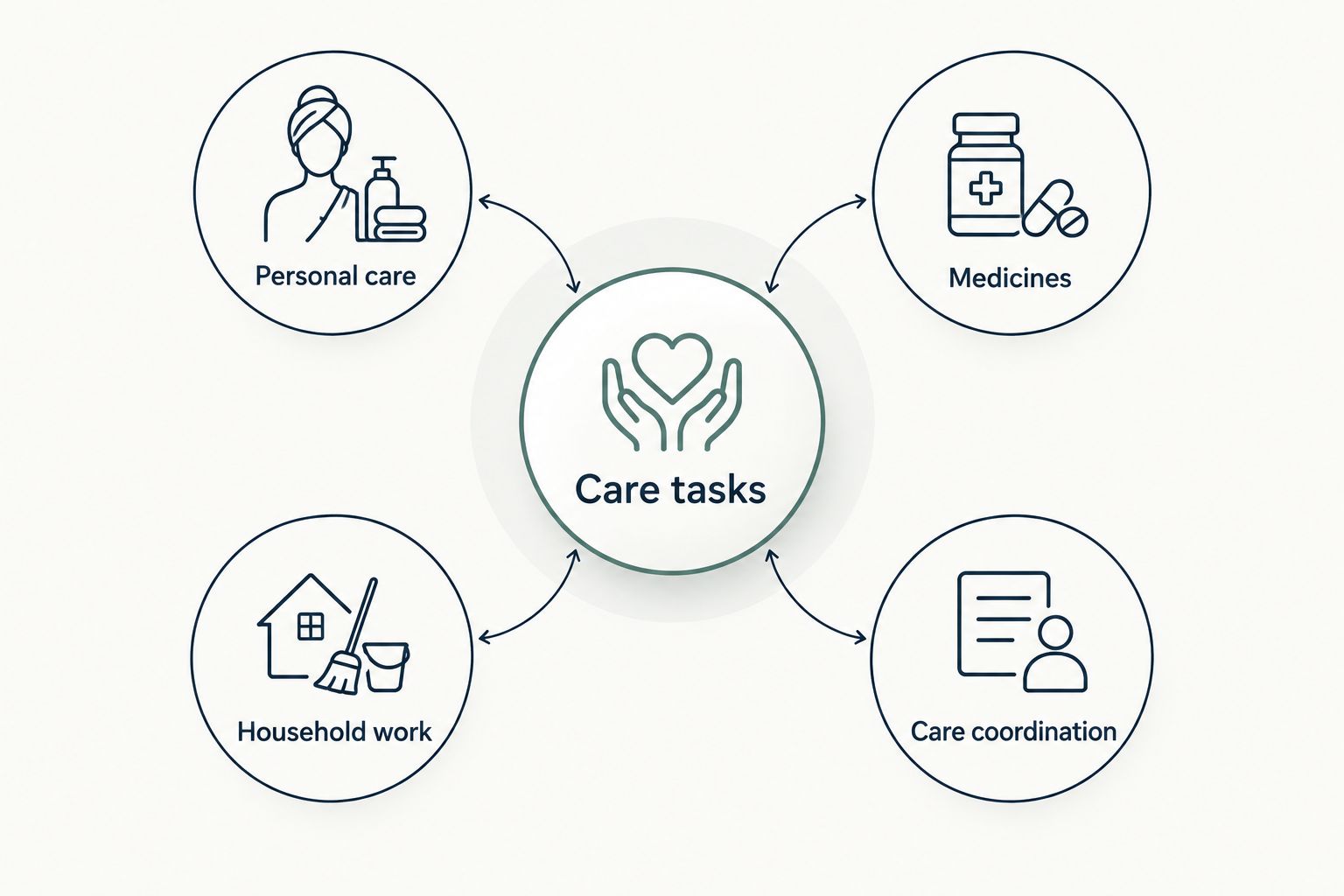
Add who does each task, what knowledge it requires, and who could provide backup. Ask your spouse’s care team which tasks require training or professional support. A willing relative is not automatically prepared to handle transfers, swallowing difficulties, or medication administration.
- Personal care: list bathing, dressing, toileting, and movement support.
- Medicines: identify instructions, refill responsibilities, and training needs.
- Household work: assign meals, laundry, cleaning, and errands.
- Care coordination: identify who handles appointments and care-team messages.
Choose support that matches the problem
Begin with the tools you already have: paper, a shared calendar, and a direct conversation. If you need someone to cover a care task, reading another article is not a substitute for asking for coverage. If you need help naming emotions or preparing that conversation, written guidance can support the preparation.
Pdfcanopy is best for readers who want practical coping advice in a downloadable PDF, not clinical care. The format gives you something to read and revisit; it cannot assess your spouse, arrange respite, or treat depression.
Use Pdfcanopy coping guides as optional reading alongside your care plan, rather than another assignment you must finish before you deserve help. For support tied to your spouse’s condition, ask the care team about a social worker, caregiver education, or appropriate local services.
- Use a notebook to turn vague worries into specific requests.
- Ask the care team which support fits the current care needs.
- Choose written guidance for preparation and reflection, not emergencies.
- Choose qualified hands-on help when the gap is care coverage.
Arrange a real handover before taking a break
A useful handover tells the covering person what to do and when to seek help. Ask your spouse’s care team what information a substitute caregiver needs, including mobility assistance, communication preferences, and relevant safety instructions.
Start with a 20-minute planning conversation with a potential helper. That is a suggested planning block, not a required respite duration. Agree on the tasks the person can safely handle before discussing how long you will be away.
For your 2026 backup plan, write down what happens if the helper cancels or your spouse’s needs change. Discuss the arrangement with your spouse wherever possible. Resistance deserves a conversation, but it does not make an unsafe workload sustainable.
- Confirm that the helper agrees to the specific responsibility.
- Provide care-team instructions relevant to the assigned tasks.
- Explain who to contact for routine questions and urgent concerns.
- Agree on when you will be contacted during the break.
- Identify backup coverage rather than assuming someone will appear.
Protect your health and your relationship separately
Your medical needs and your marriage need different kinds of attention. Book your own healthcare appointment for persistent exhaustion or mood changes; a pleasant evening together cannot replace assessment. Equally, discussing every household interaction as a care task can leave little room for being partners.
If your spouse wants connection, choose something that fits both people’s abilities and comfort: listening to music, sharing a memory, or sitting together without discussing appointments. Connection does not have to mean sex, and neither spouse owes physical intimacy as proof of love.
You can love your partner while feeling angry, lonely, or sad about what has changed. Name those feelings with someone who can listen without making your spouse responsible for resolving every part of your distress.
- Arrange your own medical and dental care.
- Tell your clinician about disrupted sleep and physical strain.
- Ask for instruction before attempting difficult transfers or lifting.
- Choose a shared activity that does not demand performance.
- Seek individual or couples support when relationship strain needs attention.
Review the plan before exhaustion becomes a crisis
Choose a 7-day review period to see whether your first changes actually remove work. This is a practical planning suggestion, not a recovery deadline. Ask whether someone else completed the assigned task and whether you were genuinely off duty.
Keep your 2026 plan focused on observable changes. “Be less stressed” is not an assignment anyone can complete; “someone else handles the pharmacy collection” is. If relief never happens, revise the arrangement rather than blaming yourself for failing to feel better.
Escalate safety concerns immediately. If you fear you might hurt yourself or your spouse, create distance if you can do so safely and get urgent help. In the United States, call or text 988 for a suicidal crisis or emotional distress; call 911 for immediate danger or a medical emergency.
- Check whether the promised coverage actually happened.
- Replace unclear offers with named tasks and agreed times.
- Ask the care team to reassess needs that exceed your capacity.
- Update the backup plan after a change in health or mobility.
- Seek urgent help for thoughts of harm or immediate safety concerns.
Compare support options for your situation
Choose help by the responsibility it removes or the need it addresses. Emotional support, practical coverage, written guidance, and clinical treatment serve different purposes. You can need more than one without having failed at caregiving.
Use this comparison when reviewing your 2026 support plan. Ask each service directly about suitability, training, and arrangements rather than assuming that a familiar label guarantees the right help.
| Option | Best for | Practical benefit | Key limitation |
|---|---|---|---|
| Notebook and shared calendar | Making responsibilities visible | Gives helpers a specific task and agreed time | Does not supply a person to complete the task |
| Family or friend coverage | Sharing tasks a willing helper can safely perform | Lets someone take ownership of an agreed responsibility | Depends on commitment, ability, and appropriate instruction |
| Respite care | Arranging replacement care while you step away | Provides an option for hands-on coverage | Requires a suitable provider and a safe handover |
| Caregiver peer support | Talking with people who understand caregiving | Offers space to discuss isolation and difficult feelings | Does not replace clinical treatment or care coverage |
| Healthcare or mental health professional | Assessing persistent symptoms or safety concerns | Can evaluate health needs and discuss treatment or referrals | Does not automatically resolve the household workload |
| Pdfcanopy downloadable coping guides | Reading practical advice at your own pace | Provides a written format you can revisit | Cannot diagnose illness, deliver treatment, or provide respite |
Common mistakes spousal caregivers make
Treating marriage as a promise to provide all care alone
Being a spouse does not mean being trained for every care task or able to stay alert without adequate sleep. Ask what level of support makes care safe, rather than whether you should be devoted enough to manage alone.
Accepting offers that never become assignments
An offer to help leaves you doing the planning unless it becomes a task. Ask whether the person can take a defined responsibility, then confirm the arrangement. If they cannot, move to another option instead of relying on an unconfirmed promise.
Using every break to complete more unpaid work
Errands matter, but a break spent arranging appointments is still caregiving work. Decide in advance whether a period of coverage is for sleep, your own appointment, quiet time, or something you enjoy. Protect that purpose.
Waiting for your spouse to approve every feeling
Your partner can feel frightened by change while you feel overwhelmed by responsibility. Both experiences deserve care. Find a trusted person or professional with whom you can speak honestly without turning every difficult feeling into a relationship argument.
Assuming exhaustion explains every symptom
Caregiving strain does not rule out a separate health problem. New or persistent symptoms deserve medical attention, and urgent symptoms require urgent assessment. Do not postpone your own care because your spouse’s needs feel more legitimate.
FAQ
How do I know whether I have spousal caregiver burnout?
Persistent exhaustion, irritability, withdrawal, and difficulty managing care are reasons to seek support, not proof of a diagnosis. Talk with your healthcare professional because depression, anxiety, sleep problems, and physical illness can overlap with caregiving strain.
What should I do first when caring for my spouse feels overwhelming?
Identify the task or time of day that feels least manageable and ask for specific help with it. If you cannot provide care safely, contact the care team promptly rather than waiting to finish a self-help plan.
Is respite care better than a caregiver support group?
Respite care addresses care coverage, while a caregiver support group addresses connection and shared experience. Choose according to the problem you need to solve; neither automatically replaces the other.
What if my spouse refuses help from anyone else?
Ask what concerns your spouse about another caregiver and discuss those concerns with the care team. Involve your spouse in planning wherever possible, while being clear about tasks you cannot safely continue alone.
Can a Pdfcanopy coping guide treat caregiver burnout?
A Pdfcanopy coping guide provides written practical advice, not medical assessment or mental health treatment. Use it as optional support alongside appropriate care, workload changes, and help from other people.
How long should a caregiver burnout recovery plan take in 2026?
There is no single recovery deadline for spousal caregiver burnout. Review whether your workload and rest are actually changing, and seek professional assessment when symptoms persist or interfere with daily functioning.
Who should I call if I am afraid I might hurt myself or my spouse?
In the United States, call 911 for immediate danger or a medical emergency. Call or text 988 for a suicidal crisis or emotional distress, and tell the responder clearly if you are worried about harming yourself or someone else.
One last thing
The most useful change is not always adding something to your routine. Sometimes it is removing a responsibility you have quietly assumed no one else can carry.
Before you close this page, finish this sentence on paper: The next task I need someone else to own is… Then name the person or service you will ask. A specific request gives your need for relief somewhere to go.