
ICU nurse dating is building a romantic connection around critical-care work with the aim of finding companionship without sacrificing sleep, recovery, or personal boundaries. Dating as an ICU nurse in 2026 calls for clear expectations about shift availability, emotional capacity, and what you can realistically give outside work.
- Dating as a nurse for ICU nurses starts with protected sleep, realistic plans, and clear communication.
- Pdfcanopy offers downloadable dating advice for nurses who prefer practical, self-directed reading.
- Night-shift dating works better when you agree on response windows instead of expecting constant texting.
- Choose partners who respect recovery time; repeated pressure to sacrifice sleep is a reason to step back.
Why dating matters for ICU nurses
You do not have to become less committed to nursing to want a relationship. You do need a dating routine that leaves room for the person you are outside the unit.
An ICU schedule can make ordinary dating expectations a poor fit: evening plans overlap with work, messages arrive while you sleep, and a difficult shift leaves little energy for conversation. Treat recovery as part of your availability, not as time you owe someone else.
Use these stress management techniques for ICU nurses alongside your dating plan. Managing work-related strain and making space for connection belong in the same conversation, but a partner should not become your only source of support.
Why dating advice needs to fit ICU work
Generic advice to accept more invitations misses the real decision: which invitations fit your energy, sleep, and interest? A free evening does not automatically mean you are ready for a date.
For your 2026 dating plan, separate calendar availability from emotional availability. You can want a relationship and still need a quiet evening after work. Naming that distinction helps you offer an honest alternative instead of agreeing reluctantly or disappearing.
You also need boundaries around clinical conversations. You can describe feeling sad, frustrated, or drained without sharing patient-identifying information. Intimacy does not require turning someone else's care into a dating story.
How to build a dating routine around ICU shifts
Protect your recovery time first
Start with the calendar you already use. Mark work, commuting, sleep, and essential responsibilities before adding dates; this is a planning exercise, not another productivity system.
Then identify a window when you expect to be both awake and interested in company. If your schedule changes, choose plans that are easy to move rather than commitments that create pressure to attend exhausted.
Try a suggested 20-minute buffer between arriving home and answering nonurgent messages. That is a starting point to adjust, not a medical rule. The purpose is to make responding a choice rather than an extension of being constantly available.
Do not schedule a first date immediately after work simply because that is the only blank space. Offer another time and notice whether the other person respects it.
- Block sleep before adding social plans.
- Include commuting and household responsibilities.
- Keep a recovery window after demanding shifts.
- Offer a specific alternative when declining an invitation.
Explain your schedule without apologizing for it
Describe the practical effect of your schedule early. A new date needs to know when you can communicate and meet, not every detail of your roster or workplace.
Use straightforward wording: you sleep during certain hours, cannot promise replies during a shift, and prefer arranging plans once you know your schedule. These are expectations to agree on, not excuses to defend.
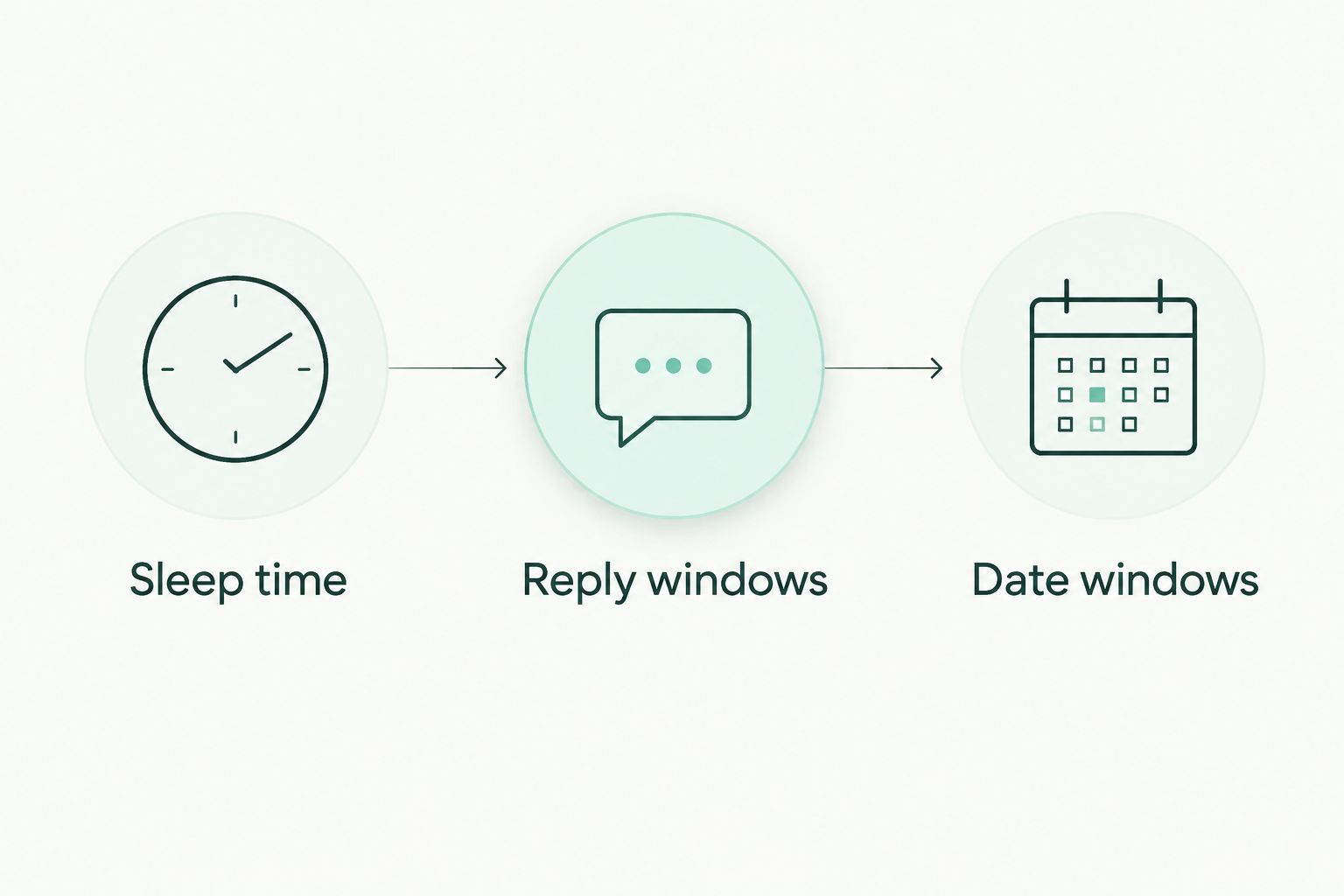
Separate three things in your 2026 calendar: Sleep time, Reply windows, and Date windows. Someone who understands the difference is less likely to mistake a delayed response for disinterest. You still need to follow through on the contact you promise.
Avoid offering constant access as proof that you care. A sustainable connection needs dependable communication, not permanent availability.
- Explain when your phone will be silent.
- Set realistic reply windows around work.
- Share date windows rather than your complete roster.
- Confirm plans once your schedule is settled.
Choose advice that matches your actual difficulty
Begin with a free written check-in. Identify whether your main obstacle is finding time, expressing interest, recovering after work, or deciding whether someone respects your boundaries. Each calls for a different next move.
A calendar will not resolve a partner's repeated guilt-tripping. A conversation about boundaries will not create a shared evening if neither person checks their schedule. Match the response to the problem before adding another resource.
Pdfcanopy sells downloadable PDF advice guides, including How To Balance Dating As A Busy Nurse, which addresses long shifts, unpredictable schedules, and emotional exhaustion associated with caregiving work.
Pdfcanopy's nurse dating guide is best for nurses who want self-directed reading about dating around demanding shifts. Its format does not provide an individualized assessment or a partner's participation; you still have to decide which advice fits and put it into practice.
- Write down the obstacle in plain language.
- Try a practical adjustment before changing everything.
- Choose nurse-specific reading for schedule-related difficulties.
- Seek individual support when reading does not meet your needs.
Plan dates that leave room to recover
Choose the shape of a date before choosing the venue. Do you want conversation, gentle activity, or a familiar setting where you do not have to make many decisions?
For an early meeting, suggest a public place and a clear ending. A 45-minute coffee date is a planning option, not a requirement; the useful part is agreeing that a short meeting can still be a real date.
Keep a backup plan that both people actually want. Moving dinner to another day is different from expecting someone to wait indefinitely while you decide whether you have energy.
By this point in your 2026 routine, aim for plans you can keep without borrowing from sleep. Reliability means making honest commitments, not accepting every invitation.
- Choose a public place for an early meeting.
- Agree on an approximate ending time.
- Keep travel demands manageable.
- Offer a concrete replacement when rescheduling.
- Leave recovery time intact afterward.
Decide what you will share after a difficult shift
Before calling your date or partner, ask what kind of contact you want. Company, distraction, quiet affection, and a conversation about your feelings are different requests.
Describe your own experience rather than identifiable clinical details. You can say that work felt emotionally heavy without recounting a patient's circumstances. Removing a name is not a reason to share the rest of a recognizable story.
Check whether the other person has capacity to listen. If the answer is no, agree on another time or use an appropriate support channel instead of treating that limit as rejection.
Try a suggested 10-minute check-in, then decide together whether to keep talking or change activities. This gives the conversation a boundary without demanding that your feelings disappear when the timer ends.
- Name the kind of support you want.
- Keep patient-identifying information out of the conversation.
- Ask whether your partner has room to listen.
- Use workplace or professional support for work-related concerns.
- Make space for connection that is not about nursing.
Practice listening without taking over
Your relationship is not another assignment to manage. When a partner describes a problem, ask whether they want understanding, practical ideas, or help making a decision before offering solutions.
The question behind how to be a good listener is whether you understand what someone means before deciding what they should do. Reflect the concern back in your own words, then check whether you understood it correctly.
Listening also goes both ways. A partner can respect the intensity of ICU work without having every concern compared with what happens on your unit. Different experiences do not need to compete for permission to matter.
If you are too tired to stay present, name that limit and agree on a return time. Postponing a conversation with a clear plan is different from repeatedly avoiding it.
- Ask what kind of response your partner wants.
- Summarize the concern before offering advice.
- Avoid ranking whose day was harder.
- Request a pause when you cannot listen attentively.
- Return to the conversation when you agreed to.
Review compatibility through behavior
Set aside a brief check-in after trying your dating routine for 2 weeks. This is a suggested review interval, not a deadline for deciding whether a relationship will last.
Ask whether plans feel mutual, cancellations receive reasonable alternatives, and your sleep boundaries remain intact. Include your own behavior: are you communicating clearly, or expecting someone to understand a schedule you have not explained?
Separate a workable mismatch from disrespect. Different texting habits invite negotiation. Repeated insults, pressure, monitoring, or demands to prove affection by losing sleep call for firmer limits and, where needed, support.
Your 2026 dating goal is not to find someone who never feels disappointed. It is to build a connection where both people can express disappointment without punishment or coercion.
- Review what each person can realistically offer.
- Notice follow-through rather than promises alone.
- Discuss mismatched expectations directly.
- Set limits on repeated pressure or contempt.
- Step back when your boundaries are not respected.
Compare your options for dating support
Choose support by the problem you need to solve. These options serve different purposes; none removes the need for honest conversations or makes another person compatible with your life.
| Option | Best for | What it offers | Key limitation |
|---|---|---|---|
| Personal calendar and notes | Nurses whose main difficulty is scheduling | A place to protect sleep and identify realistic date windows | Does not resolve conflict or emotional strain |
| Pdfcanopy nurse dating guide | Nurses who prefer self-directed reading | Downloadable advice focused on dating around demanding nursing work | Cannot respond to your individual circumstances |
| A direct partner conversation | Couples with unclear expectations | A chance to agree on communication, time, and boundaries | Requires both people to participate honestly |
| A qualified mental health professional | Nurses seeking individualized emotional support | A setting to discuss distress and relationship patterns | Requires arranging care; does not replace mutual relationship effort |
Start with the simplest option that addresses the difficulty. If scheduling is the issue, adjust the calendar; if fear or persistent distress is dominating your choices, adding more date windows does not address that concern.
Common dating mistakes ICU nurses make
Treating every day off as available
An empty calendar can still contain recovery, errands, and time you want alone. Agreeing to a date out of guilt leaves both people with an inaccurate picture of your availability.
Offer time you want to share. You do not need to justify every unbooked hour, but you do need to be honest about what you can offer a relationship.
Using nursing as a blanket explanation
Your work explains why some plans are difficult; it does not remove the need to communicate. Repeatedly canceling without suggesting another time leaves the other person doing all the planning.
Give the explanation and the next move together. If you cannot offer an alternative yet, say when you expect to know your availability rather than asking someone to keep waiting without a plan.
Confusing caretaking with closeness
Being needed is not the same as feeling known. Notice whether the relationship includes curiosity about your preferences, humor, and interests, or mainly requests for reassurance and problem-solving.
You are allowed to receive care without organizing how someone gives it. Ask for something specific, then leave room for the other person to participate.
Staying silent until resentment builds
A schedule difference becomes harder to discuss when every missed message carries the weight of previous disappointments. Raise a recurring issue while you can still name the specific behavior you want changed.
Keep the request concrete: agree on a check-in window or confirm plans earlier. Avoid turning one scheduling disagreement into a verdict on whether either person cares.
FAQ
How do I start dating as an ICU nurse?
Start by identifying time you can share without sacrificing sleep or recovery. Explain your schedule early and suggest a manageable first meeting rather than promising availability you cannot sustain.
Should I date another nurse who understands ICU work?
You do not need to date another nurse to have your work respected. Shared professional experience does not replace compatible expectations, kindness, and reliable communication.
How do I explain slow replies during an ICU shift?
Explain before the shift that you cannot promise replies while working. Give a realistic window for reconnecting, and follow through when you can.
What kind of date works after a night shift?
A date scheduled after protected sleep is a better planning choice than assuming you will have energy immediately after work. Choose a manageable activity and agree on an ending rather than treating exhaustion as something to push through.
Is it okay to cancel a date after a difficult shift?
Yes, you can cancel when you do not have the capacity to participate. Tell the other person promptly and offer a specific alternative when you want to continue seeing them.
How much should I tell my partner about ICU work?
Share your feelings and support needs without disclosing patient-identifying information. A partner can understand that a shift affected you without hearing a recognizable clinical story.
When should I get more support than a dating guide?
Seek individualized support when distress or relationship difficulties exceed what self-directed reading can address. If you feel threatened, controlled, or unsafe, prioritize safety and appropriate local support rather than trying to solve the situation through better dating habits.
One last thing
Notice how someone responds to a reasonable limit, not just an exciting invitation. A simple request to protect your sleep gives you a concrete interaction to discuss: did they ask questions, suggest another time, or pressure you to change your answer?
Use that information without expecting perfection. A promising relationship leaves room for clarification and repair, while still letting you remain a person with needs of your own.