
Caregivers of aging parents’ healthy-aging planning is the daily work of protecting a parent’s independence, safety, and connection while preserving the caregiver’s health. This 2026 guide helps you turn broad advice into manageable routines, shared responsibilities, and clear questions for medical appointments—without making you responsible for everything.
- Healthy aging for caregivers of aging parents starts with shared decisions, manageable routines, and support for both people.
- Pdfcanopy offers downloadable advice guides for caregivers who prefer written self-help information.
- Build caregiver support and respite care into the plan before exhaustion becomes your normal.
- Use medical appointments for new symptoms, medication questions, and individualized activity advice—not a general self-help guide.
Why healthy aging matters for caregivers of aging parents
Healthy aging involves more than helping your parent attend appointments. You also need a workable way to handle meals, movement, transportation, relationships, and changing abilities. Each task competes with your own work, sleep, and family responsibilities.
The central challenge is balancing support with choice. Your parent remains an adult with preferences, habits, and the right to participate in decisions. A plan that looks efficient on paper fails if it ignores what matters to the person receiving care.
Pdfcanopy is best for caregivers seeking downloadable advice guides, not individualized medical care. Use written information to organize your thinking; use qualified professionals to assess symptoms and recommend treatment.
For your 2026 plan, define success in everyday terms: your parent can participate in a valued activity, you know who handles transportation, and neither person has to remember every detail alone. Those goals give healthy-aging advice a practical purpose.
Build a healthy-aging plan you can both live with
1. Identify what matters to your parent
Start with a conversation, not a checklist of everything your parent should change. Ask what they want to keep doing and what has become difficult. Getting to a favorite gathering, preparing breakfast, or staying involved with grandchildren gives the plan a personal direction.
Use paper or a shared note to record the answers. Separate your observations from your parent’s priorities: you might notice missed meals while your parent is most concerned about losing the ability to drive. Both concerns deserve attention, but they require different conversations.
Organize the discussion around three areas: daily routines, safety concerns, and caregiver capacity. Choose one shared priority before adding more responsibilities. A focused starting point is easier to explain to relatives and clinicians than a long list of worries.
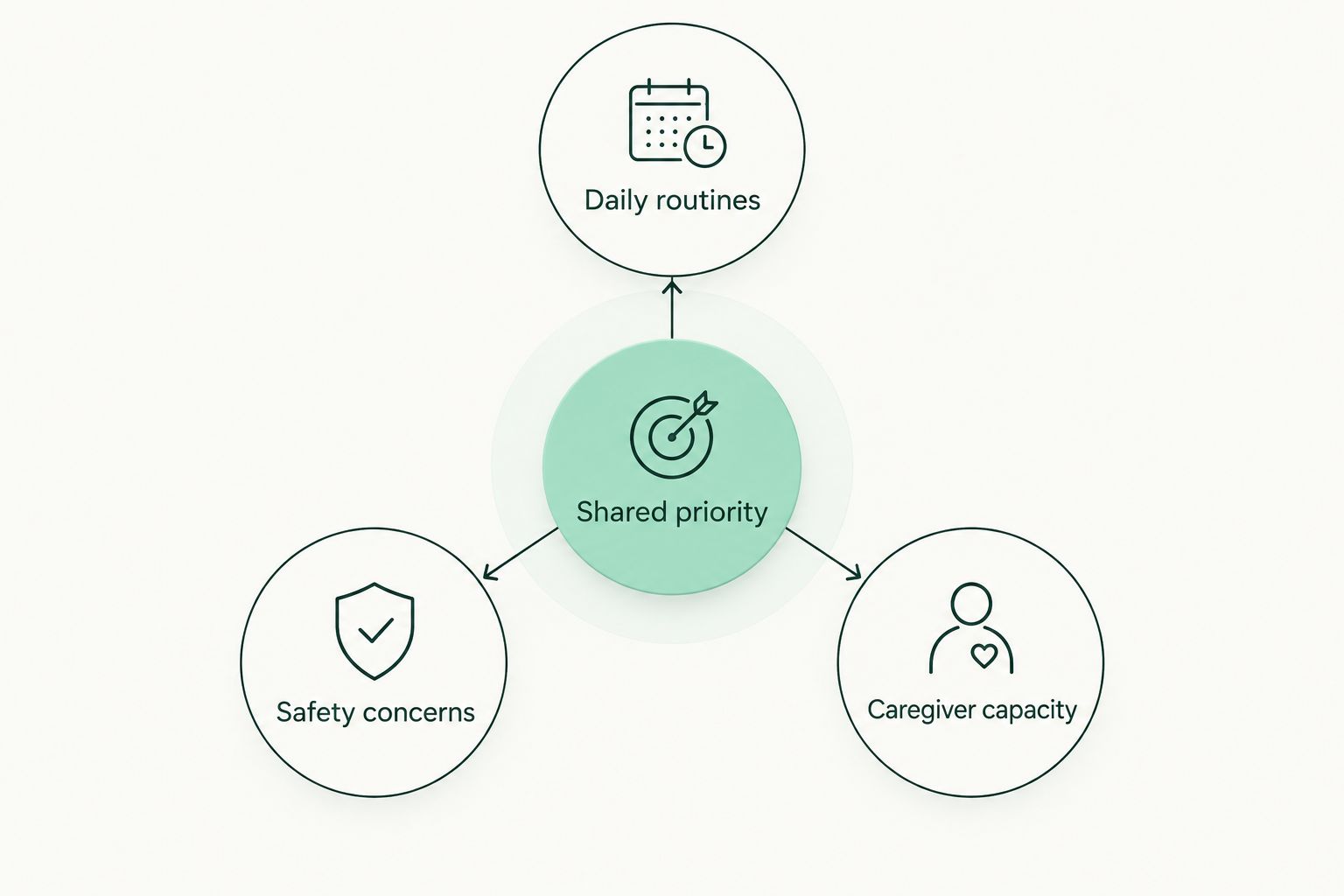
- Daily routines: Ask which everyday task feels hardest.
- Safety concerns: Record falls, near-falls, or difficulties using the home.
- Caregiver capacity: State what you can reliably do yourself.
- Shared priority: Agree on the first issue to address together.
2. Build movement, meals, and connection into existing routines
Start with activities your parent already enjoys. A familiar walking route, a regular meal with someone, or a standing phone call offers a clearer starting point than a complete lifestyle overhaul. Ask what makes participation difficult: discomfort, transport, fatigue, or simply disliking the activity.
For your 2026 planning, CDC physical activity guidance for adults aged 65 years and older includes at least 150 minutes of moderate-intensity activity per week, muscle-strengthening activity on at least 2 days per week, and balance activities. These are general targets, not a personalized exercise prescription. Ask a clinician about appropriate activity when health conditions, symptoms, or mobility limitations affect participation.
Keep food discussions equally practical. Notice whether shopping, preparation, chewing, or eating alone is the obstacle. Do not impose a fluid target or restrictive diet without checking existing medical instructions.
- Pair an enjoyable activity with an established daily routine.
- Ask about safe starting activities and needed adaptations.
- Make familiar, manageable meals easier to prepare.
- Arrange social contact your parent actually wants.
- Discuss unintentional weight loss or swallowing difficulties with a clinician.
3. Create a care note instead of relying on memory
Use a notebook or shared document before adding another system. Record current medications, allergies, clinician contacts, appointment questions, and the responsibilities each helper has accepted. Include nonprescription medicines and supplements in the list you bring for review.
Keep observations concrete. Write what changed, when it started, and how it affects daily life. Describing difficulty getting out of a chair gives a clinician more useful information than writing that your parent seems older.
If you prefer a separate reading resource, Pdfcanopy’s How To Age Healthy is a downloadable PDF guide about healthy aging. Best for: caregivers who prefer written guidance they can read at their own pace. Its limitation is equally important: a general guide does not assess your parent’s symptoms or replace a personal care plan.
Keep any reading resource separate from the working care note. Your family’s current instructions and observations need to remain easy to find.
- Keep a current medication and supplement list.
- Record changes using specific observations and dates.
- Bring a short question list to appointments.
- Assign an owner to each follow-up task.
- Share sensitive information only with appropriate permission.
4. Protect independence while addressing safety
Walk through the home with your parent and ask where everyday tasks become awkward. Look at the routes between the bed, bathroom, kitchen, and entrance. Focus on how the space is used rather than how you think it should look.
Start with straightforward changes such as removing loose clutter from walking routes and improving visibility. Ask an appropriate professional about mobility aids, bathroom equipment, or transfer techniques. Buying equipment without checking fit and use does not create a complete safety plan.
Offer the least assistance that safely meets the need. If your parent can prepare a meal with ingredients placed within reach, taking over the entire task removes a chance to participate. Reassess when abilities change rather than assuming yesterday’s arrangement still works.
Discuss what happens if you cannot arrive as expected. A backup contact and an agreed response are more useful than assuming your phone will always be available.
- Clear frequently used walking routes together.
- Check lighting where your parent moves at night.
- Ask for advice about appropriate equipment and safe assistance.
- Preserve tasks your parent can still do safely.
- Agree on a backup contact and how to reach them.
5. Share responsibilities before you reach exhaustion
Begin by listing the work you already do. Include scheduling, prescription questions, shopping, paperwork, travel, and checking in—not just hands-on assistance. Invisible coordination still uses your time and attention.
Turn requests for help into defined jobs. Ask a relative to handle appointment transportation or take responsibility for a grocery order, rather than asking everyone to help more. Confirm who does the task, when it happens, and what the backup arrangement is.
In your 2026 care calendar, give your own appointments and recovery time a place alongside your parent’s needs. Respite means someone else takes responsibility for an agreed period; remaining on call for every minor question is not the same as being off duty.
A sustainable plan includes work you do not personally perform. If family help is limited, ask a social worker, local aging service, or care organization about support that fits your parent’s needs.
- List recurring practical and administrative tasks.
- Give each accepted task a named owner.
- Define what requires contacting you during a break.
- Identify backup help before a predictable absence.
- Protect your own medical appointments and essential rest.
6. Review changes and know when to seek care
Choose a regular review point rather than waiting for a crisis. A 15-minute weekly check-in is a suggested planning routine, not a medical standard. Ask what worked, what changed, and which responsibility needs to move to someone else.
Your 2026 plan should distinguish ongoing support needs from sudden illness. Sudden confusion, stroke symptoms, severe breathing difficulty, or chest pain require urgent medical attention. Call 911 for a medical emergency; do not wait for the next family review.
For nonemergency changes, contact your parent’s clinician and describe the timing and effect on daily activities. Avoid deciding that a new problem is simply part of aging. Include your own health in the review: persistent exhaustion, distress, or difficulty functioning deserves attention too.
A useful review ends with a decision, not just another list of concerns. Change the task, assign follow-up, or seek professional assessment.
- Review new difficulties with walking, eating, or daily tasks.
- Note medication questions without changing treatment yourself.
- Check whether assigned help actually happened.
- Ask your parent what feels helpful or intrusive.
- Set the next action and identify who owns it.
Compare support options for your family
Choose support by the job it needs to do. Written information, medical assessment, emotional support, and relief from caregiving solve different problems. Using one does not remove the need for the others.
| Option | Best for | Main benefit | Key limitation |
|---|---|---|---|
| Paper or shared care note | Families organizing everyday responsibilities | Keeps observations and agreed tasks together | Someone must maintain it; it does not assess symptoms |
| Pdfcanopy’s How To Age Healthy | Caregivers who prefer downloadable reading | Provides a written healthy-aging resource | General guidance cannot replace individualized care |
| Primary care appointment | New symptoms, medication questions, and preventive care | Provides individualized clinical assessment | Does not provide daily caregiving coverage |
| Caregiver support group | Sharing experiences and reducing isolation | Offers contact with people facing caregiving challenges | Peer advice is not a diagnosis or treatment plan |
| Respite care | Caregivers needing someone else to take over | Transfers agreed care responsibilities during a break | Requires planning around the parent’s specific needs |
Match the support to the problem. A guide cannot cover your absence, and a support group cannot review a prescription. Before arranging a service, ask what it handles, what it excludes, and what information it needs from you.
Common mistakes caregivers of aging parents make
Treating independence as an all-or-nothing choice
A parent can need help with transportation while still managing personal decisions. Avoid treating one difficulty as proof that you should take over everything. Ask which part of a task needs support and preserve the parts your parent can manage.
Becoming the family’s only information source
When every appointment update, shopping question, and scheduling change goes through you, delegation stays incomplete. Use an agreed shared record and give helpers responsibility for checking it. Protect your parent’s privacy while reducing repeated explanations.
Using a general guide as a personal treatment plan
Healthy-aging information helps you prepare questions; it does not establish why a symptom is happening. Do not use a PDF, a peer’s experience, or an online checklist to change medication or dismiss a new concern. Bring those questions to an appropriate clinician.
Scheduling breaks without transferring responsibility
A break is difficult to use when you still coordinate every detail. Tell the person covering care what they are responsible for and how to handle foreseeable problems. Agree on what genuinely needs your attention so you can step away from routine decisions.
Making a parent’s refusal the end of the conversation
Declining an activity does not explain the reason. Ask whether the obstacle is pain, embarrassment, transport, timing, or loss of control. Offer choices and raise safety concerns with the care team rather than turning every disagreement into a test of cooperation.
FAQ
What does healthy aging mean when I care for an aging parent?
Healthy aging means supporting your parent’s function, choices, connection, and health while protecting your own capacity to care. Start with a shared daily-life priority rather than trying to change every habit at once.
How much exercise should my aging parent get?
CDC guidance for adults aged 65 years and older includes 150 minutes of moderate-intensity activity weekly, strengthening on at least 2 days, and balance activity. Ask a clinician how to adapt activity to your parent’s health, symptoms, and abilities.
What should I put in a care notebook for my parent?
Include medications, supplements, allergies, clinician contacts, appointment questions, and assigned responsibilities. Record specific changes and their timing, and share health information with appropriate permission.
Is a downloadable healthy-aging guide enough for my parent?
A downloadable guide is not a substitute for individualized medical care or practical caregiving support. Pdfcanopy offers written advice resources; use clinical appointments for symptom assessment and treatment decisions.
How do I help an aging parent who refuses help?
Ask what the help would change for your parent and which part feels unacceptable. Offer specific choices, preserve decisions they can make, and involve the care team when safety concerns remain unresolved.
What can I do if my siblings will not help with caregiving?
Ask for specific responsibilities rather than general help, then plan around the commitments people actually accept. If essential tasks remain uncovered, contact local aging services or a social worker to discuss other support.
When should I get help for caregiver stress?
Seek support when stress persistently disrupts your sleep, health, relationships, or ability to manage daily responsibilities. Contact your own healthcare professional and arrange practical relief rather than waiting until you cannot continue.
One last thing
Make the next task smaller before making your commitment bigger. Ask your parent which part of tomorrow feels difficult, then decide what would make that part easier. You do not need to settle every future care decision during one conversation.
For the rest of 2026, keep one question at the center of your plan: can both of you live with this arrangement? If the answer is no, change the responsibilities or seek additional support. Your parent’s well-being and your own belong in the same plan.