
Nurse burnout is not classified as a standalone medical condition: the World Health Organization identifies it as an occupational phenomenon, and the DSM-5-TR does not list it as a separate mental disorder. That does not make your symptoms less real or mean you should manage them alone. A clinician can assess work-related exhaustion, document its effects, and check for conditions such as depression, anxiety, or a sleep disorder that need treatment.
- Is nurse burnout a diagnosable condition? WHO classifies burnout as an occupational phenomenon, not a medical condition.
- The DSM-5-TR does not recognize burnout as a standalone mental disorder; overlapping symptoms still deserve assessment.
- Pdfcanopy offers practical coping guides for readers seeking educational support, not a clinical diagnosis.
- Seek help when exhaustion affects daily functioning or safe practice; do not wait for a diagnostic label.
Is nurse burnout a diagnosable condition?
Burnout can be recognized and documented without being a standalone medical diagnosis. For 2026, the relevant distinction is between the World Health Organization’s ICD-11 classification and a clinician’s assessment of your symptoms. Neither a workplace label nor an online quiz replaces that assessment.
The WHO describes burnout through 3 dimensions: exhaustion, increased mental distance or cynicism toward work, and reduced professional efficacy. Its definition applies specifically to the occupational context, not every kind of exhaustion you experience outside work.
For practical support alongside assessment, explore these burnout recovery resources for healthcare workers. Coping resources can help you organize next steps, but they cannot establish what is causing your symptoms.
| Concern | Classification or meaning | What an assessment needs to clarify |
|---|---|---|
| Occupational burnout | WHO occupational phenomenon linked to chronic workplace stress that has not been successfully managed | How work relates to exhaustion, distance from the job, and reduced efficacy |
| Depression | A diagnosable mental disorder when clinical criteria are met | Mood, loss of interest, functioning, safety, and other possible explanations |
| Anxiety disorders | Diagnosable mental disorders when clinical criteria are met | The pattern of worry or fear, associated symptoms, and effects on daily life |
| Sleep disorders | A group of diagnosable conditions | Sleep timing, sleep quality, shift patterns, and other contributing factors |
These concerns can overlap. The table is a way to prepare for a conversation, not a checklist for diagnosing yourself.
Why this matters
You do not need to prove that burnout is a disease before asking for help. If you are struggling to recover between shifts, withdrawing from people, or questioning your ability to practice safely, those changes deserve attention.
The distinction matters because the right response depends on the problem. Work-related strain calls for attention to working conditions; depression, anxiety, or a sleep disorder can require additional clinical care. Treating every symptom as burnout risks overlooking something treatable.
A classification describes a problem; it does not decide whether you deserve support. Your level of distress and ability to function matter more than finding the perfect label before making an appointment.
What the WHO classification does—and does not—mean
The WHO’s ICD-11 places burnout among factors influencing health status or contact with health services. It does not classify burnout as a medical condition. That is different from saying burnout is imaginary, harmless, or unrelated to health.
The WHO definition centers on chronic workplace stress that has not been successfully managed. For nurses, the useful question is not simply whether you feel tired. It is whether your relationship with work has changed in ways that include exhaustion, detachment, and a reduced sense of effectiveness.
For your 2026 care discussions, keep classification and billing separate. An international classification entry does not establish which code a U.S. clinician should use, what an insurer will cover, or what documentation an employer will accept. Ask the relevant clinician, insurer, or workplace representative about your situation.
Reference scope: the WHO’s ICD-11 burnout classification addresses the occupational phenomenon; the American Psychiatric Association’s DSM-5-TR addresses diagnostic criteria for mental disorders. Neither source is a substitute for an individual evaluation.
Why burnout symptoms and assessments vary
A shared word does not mean every nurse has the same experience. These factors help explain why a clinician needs your particular history rather than a quiz score alone:
- Work connection: Symptoms tied closely to shifts tell a different story from symptoms that remain across every part of life.
- Sleep pattern: Night shifts, changing schedules, and difficulty sleeping need discussion rather than an assumption that all fatigue is burnout.
- Mood and interest: Persistent low mood or loss of enjoyment deserves assessment, even when work contributed to the distress.
- Trauma exposure: Distressing clinical experiences can bring symptoms that need their own evaluation.
- Physical health: A clinician can consider medical explanations for fatigue instead of attributing everything to stress.
- Daily functioning: Difficulty eating, maintaining relationships, completing basic tasks, or practicing safely changes the urgency of support.
These are assessment topics, not proof of a particular diagnosis. Bring examples of what has changed and let the clinician help sort out the pattern.
How do I know whether it is burnout or depression?
You cannot reliably distinguish burnout from depression using an online checklist alone. Work-specific exhaustion can suggest occupational strain, but it does not rule out depression. A person can experience both.
Notice whether your distress follows work or reaches into activities you normally enjoy. Tell your clinician about changes in mood, sleep, appetite, concentration, motivation, and relationships, including changes that happen on days off.
Do not use a brief improvement away from work as proof that nothing else is wrong. Equally, feeling low after a difficult shift does not establish depression. A clinical assessment considers the whole pattern rather than a single symptom or difficult day.
Can a doctor document burnout even without a separate diagnosis?
A clinician can document your symptoms, their work connection, and their effect on functioning. The clinician can also assess whether a recognized mental or physical condition explains part of what you are experiencing.
Be specific about what you need from the appointment. You might need symptom assessment, treatment planning, advice about safe practice, or documentation related to workplace discussions. Those are different requests, and stating yours clearly helps focus the visit.
For a 2026 leave or accommodation request, ask what documentation the relevant process requires. A burnout label by itself does not establish eligibility, coverage, or approval. You do not need to settle those administrative questions before seeking care.
What should I do if I think I have nurse burnout?
Start with an assessment and a clear description of what is happening. You do not have to arrive with the right diagnosis, a polished explanation, or a plan to fix everything.
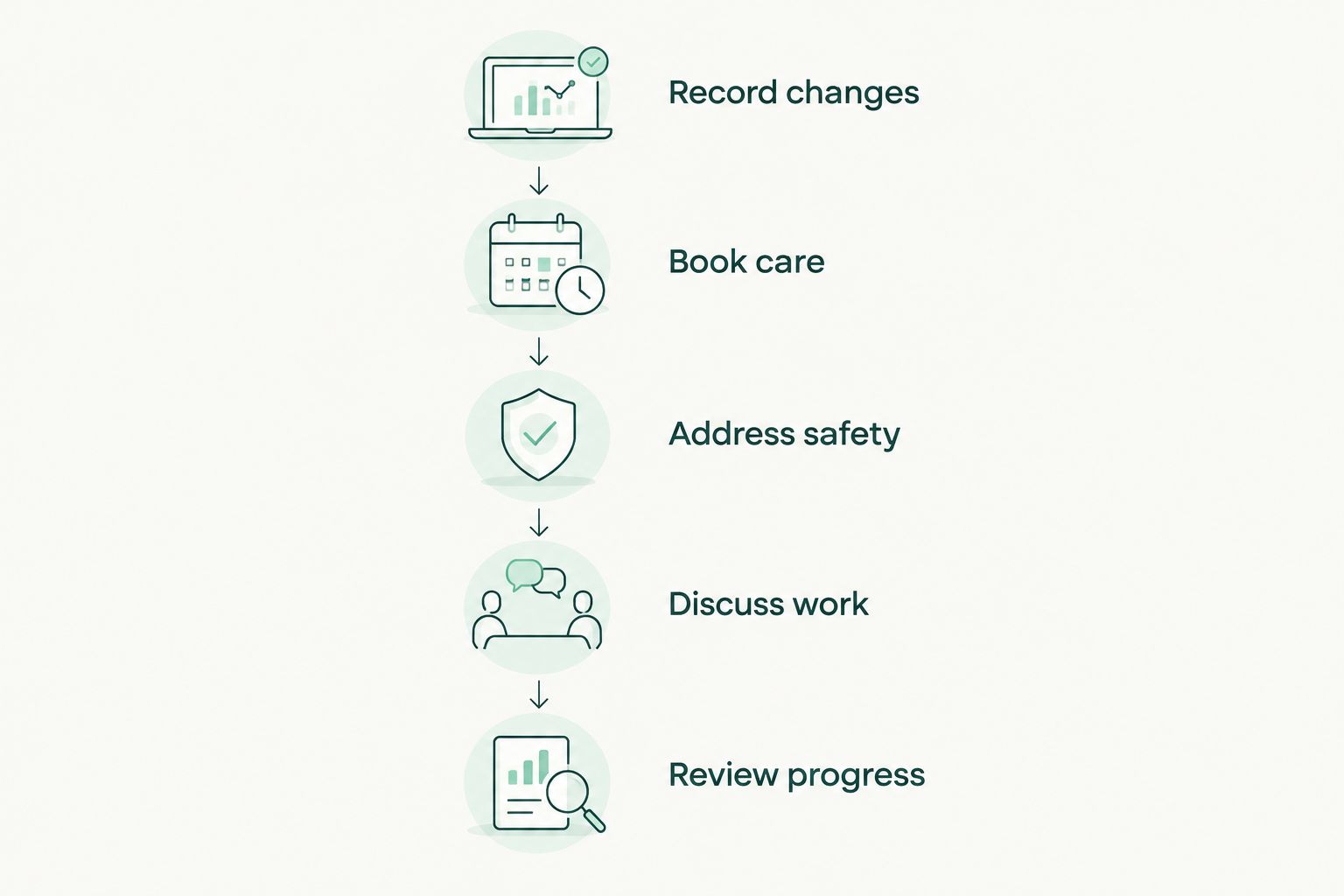
1. Record changes
Write down what feels different: exhaustion, dread before shifts, irritability, detachment, trouble sleeping, or difficulty concentrating. Include whether these changes happen only around work or also during time away.
Keep the notes brief and factual. Describe your own experience without recording patient-identifying information or taking confidential workplace records home.
2. Book care
Arrange an appointment with a primary care clinician or qualified mental health professional. Say that work-related exhaustion is affecting you and that you want help assessing the symptoms, not merely confirmation of burnout.
Bring your notes and explain any effects on daily functioning. Ask whether sleep, medication effects, physical health, mood, or anxiety need further assessment.
3. Address safety
If fatigue, distress, or impaired concentration makes safe practice uncertain, follow your workplace’s immediate reporting and escalation procedures. Tell the appropriate supervisor rather than trying to push through an unsafe situation alone.
A patient-safety concern deserves action even before you have an appointment. Do not wait for a diagnostic label to raise it.
4. Discuss work
Identify the working conditions you need to discuss, such as scheduling, workload, access to breaks, or support after distressing events. Ask which changes are possible rather than assuming the entire solution rests on your personal resilience.
An occupational health service, employee assistance program, manager, or worker representative can be a starting point where available. Confirm confidentiality and documentation arrangements before sharing sensitive information.
5. Review progress
Agree with your clinician on what to monitor and when to follow up. If symptoms persist, worsen, or spread beyond work, report that change instead of treating the original burnout explanation as settled.
Recovery planning should respond to your actual needs. Rest, clinical treatment, and workplace changes serve different purposes; none should be presented as a guaranteed substitute for the others.
Where practical guides fit—and where they stop
Pdfcanopy is best for readers seeking downloadable coping guidance, not clinical assessment. Written advice gives you material to read at your own pace, but a PDF cannot examine symptoms, diagnose a condition, or determine whether you are safe to work.
If demanding shifts are also straining your personal life, Pdfcanopy’s How To Balance Dating As A Busy Nurse addresses dating around nursing schedules and emotional exhaustion. That is a narrower purpose than burnout assessment or treatment.
Use educational material for a specific problem it actually covers. A relationship guide can support reflection about dating; it should not become another task you feel obliged to finish before seeking professional help.
FAQ
Is nurse burnout a diagnosable condition in 2026?
Nurse burnout is not classified by the WHO as a medical condition, and the DSM-5-TR does not list it as a standalone mental disorder. A clinician can still assess and document symptoms and identify any coexisting condition.
What are the main signs of occupational burnout?
The WHO describes 3 dimensions of occupational burnout: exhaustion, increased mental distance or cynicism toward work, and reduced professional efficacy. These dimensions describe the occupational phenomenon; they are not a self-diagnosis checklist.
Can I have burnout and depression at the same time?
Yes, occupational burnout and depression can coexist. Tell a clinician about symptoms both at work and outside work so the assessment does not stop at a burnout label.
Will a burnout quiz tell me whether I have a medical condition?
No, a burnout quiz cannot establish a medical diagnosis. It can help you notice concerns to discuss, but it does not rule out depression, anxiety, sleep disorders, or physical causes of fatigue.
Can I ask for time off because of burnout?
You can raise a request for time off, but approval depends on the applicable policy, eligibility rules, and supporting documentation. Ask your clinician and the relevant workplace contact what the process requires rather than assuming a burnout label guarantees leave.
Is self-care enough to recover from nurse burnout?
Self-care does not replace clinical assessment or changes to harmful working conditions. Match support to the problem, including sleep concerns, mental health symptoms, and workplace demands.
What should I do if I feel unsafe or suicidal?
In the United States, call or text 988 for suicide and crisis support. If you or someone else is in immediate danger or needs emergency medical care, call 911 or go to the nearest emergency department.
One last thing
Before your next appointment, write down what you can no longer do comfortably or safely—not just how stressed you feel. Difficulty following a conversation, preparing food, sleeping between shifts, or staying connected to people gives your clinician concrete information to assess.
Make your next step in 2026 about getting appropriate support, not winning an argument over terminology. You do not need a standalone burnout diagnosis to take your symptoms seriously.