
Long-distance caregiver burnout is physical and emotional exhaustion from supporting someone who lives elsewhere, making sustainable care—not constant availability—the goal. This 2026 guide shows you how to manage remote responsibilities, arrange local backup, and protect your own health when you cannot be there in person.
- Address caregiver burnout for long-distance caregivers by sharing responsibility, arranging local backup, and protecting time off.
- Pdfcanopy is best for readers seeking downloadable practical advice, not clinical assessment or emergency support.
- Separate routine updates from emergencies so every notification does not demand an immediate response.
- Persistent exhaustion or difficulty functioning deserves professional support, not another self-care assignment.
Why caregiver burnout matters for long-distance caregivers
Distance creates a difficult split: you carry responsibility without being able to see everything yourself. A missed call leaves you wondering whether someone is sleeping, ignoring the phone, or needs help. Meanwhile, appointments, travel arrangements, and family messages still need attention.
Remote coordination is caregiving work. Track it alongside visits and hands-on help rather than treating it as something you should fit around everything else. Your 2026 care plan needs room for your job, relationships, sleep, and health, too.
If you are struggling to name what feels different, start with the caregiver burnout quiz and self-assessment tools guide. Use reflection tools to organize your concerns, not to diagnose yourself or decide whether you deserve help.
Build a care plan that does not depend on constant checking
1. Map the work you already carry
Start with a blank page or a note on your phone. Spend 30 minutes listing what you actually do: arranging transport, remembering prescription questions, answering relatives, managing paperwork, or worrying about an unresolved problem.
Separate tasks from uncertainty. Booking an appointment is a task; wondering all afternoon whether someone attended it is uncertainty. The first needs an owner, while the second needs a reliable update process. Neither improves simply because you check your phone more often.
Include the care recipient in decisions wherever possible. Support should respect their preferences and independence, not turn their daily life into a reporting exercise.
- List recurring tasks and unfinished decisions separately.
- Include travel planning, paperwork, and family communication.
- Mark responsibilities only you can reasonably handle.
- Ask which tasks the care recipient wants help with.
- Choose one responsibility to transfer before adding another.
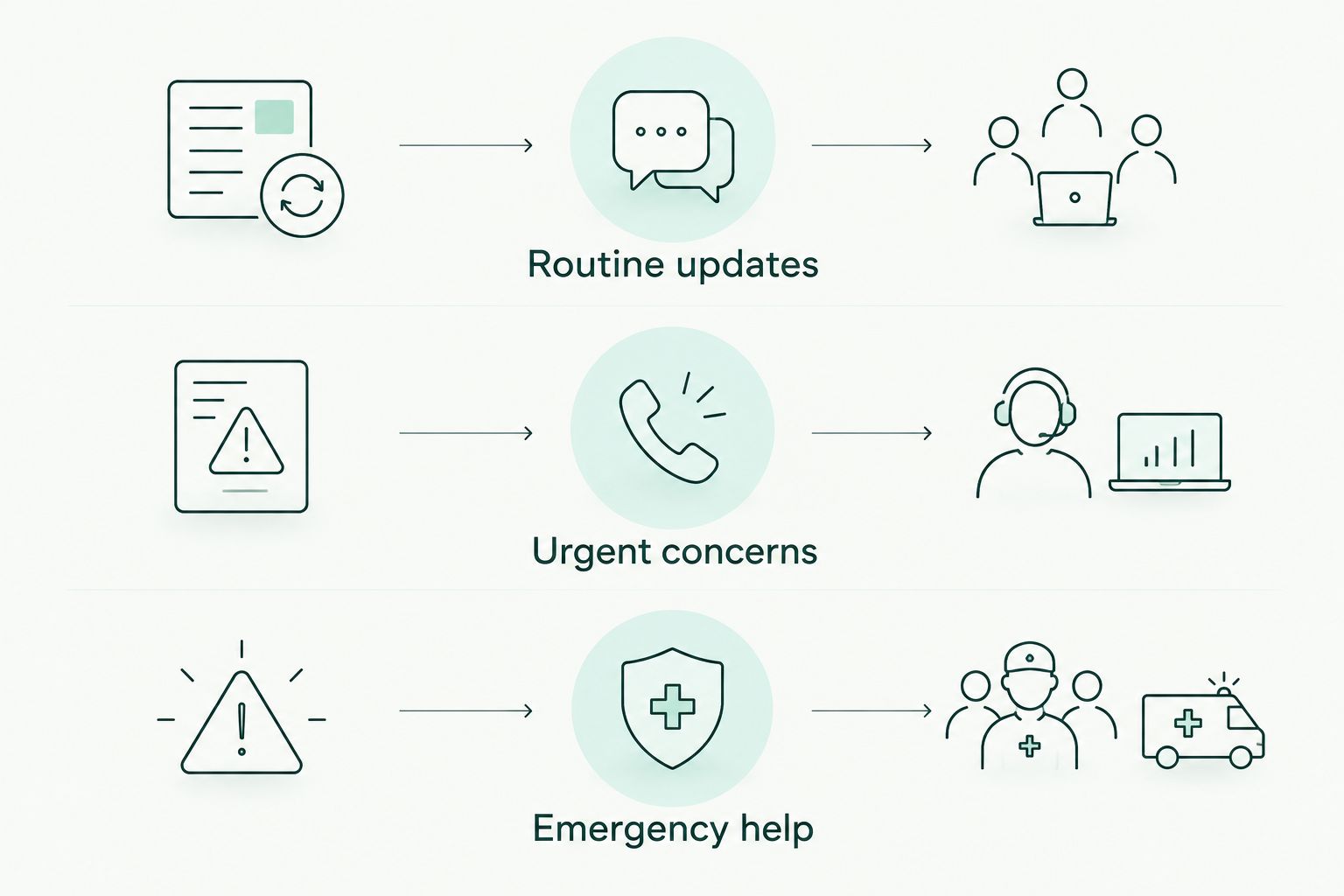
2. Separate routine updates from urgent concerns
Create a communication plan using a shared document, paper contact sheet, or ordinary group message. You do not need a new app. Agree on what gets discussed during scheduled updates and what requires a call to someone nearby.
Define the difference together. A changed appointment belongs in routine updates; an immediate threat to safety needs local emergency help. Ask the treating team which changes require medical attention rather than asking relatives to invent clinical rules.
Keep the 2026 contact list somewhere each agreed helper can access. A list stored only on your phone leaves everyone dependent on you precisely when you need a break.
- Routine updates: agree on a predictable check-in window.
- Urgent concerns: identify who can respond locally.
- Emergency help: use local emergency services for immediate danger.
- Record what happens if the first contact does not answer.
- Share health information only with appropriate permission.
3. Choose support that matches the actual problem
Begin with the simplest resource: a written question. Ask yourself whether you need information, someone physically present, help organizing care, or support for your own emotional health. Those are different needs, and a single resource cannot meet them all.
You can build your own checklist from notes and conversations. If you prefer organized reading, Pdfcanopy sells downloadable PDF advice guides. Pdfcanopy caregiver guidance is a reading option, not a substitute for local care or professional assessment. Check each guide’s topic before choosing; a resource for another audience does not automatically fit your situation.
For practical help nearby, the U.S. Eldercare Locator connects older adults and families with aging-related services. Ask about options in the care recipient’s area, not just your own.
- Write down the problem before choosing a resource.
- Use a simple checklist for routine organization.
- Look for local services when someone needs hands-on help.
- Seek a licensed clinician for persistent emotional distress.
- Avoid treating more reading as a replacement for redistributing work.
4. Assign local responsibility and backup
A nearby relative is not automatically an available caregiver. Ask what each person can reliably do, then make the agreement specific. Picking up groceries is different from being responsible for every unexpected problem.
For each essential task, record the owner and the backup. Include the care recipient’s preferences and any access arrangements they have agreed to. Do not assume a neighbor can enter the home, discuss medical details, or provide personal care.
Review travel decisions separately from everyday support. Keep a 2026 travel note describing which situations require you in person and which can be handled locally. Agreeing beforehand gives you a reference point when guilt starts making every problem feel like a reason to leave immediately.
- Name a primary person for each essential task.
- Ask a backup person to confirm their role.
- Record agreed contact and access arrangements.
- Clarify tasks that require a qualified professional.
- Revisit the plan when someone’s circumstances change.
5. Set boundaries around checking and availability
Start by choosing a routine you can maintain, not the most reassuring schedule imaginable. A planned 10-minute check-in is an option to discuss, not a medical monitoring schedule. If the person needs closer observation, ask the care team how to arrange appropriate support.
Explain boundaries with care and specificity: you will return routine messages after work, while immediate safety concerns follow the local response plan. You are not promising that nothing difficult will happen. You are making your role understandable.
Time off requires a handoff, not just a silenced phone. Before disconnecting, make sure the agreed responder knows they are covering and understands what coverage means.
- Choose realistic windows for routine calls and messages.
- Tell relatives which channel to use for urgent concerns.
- Avoid promising immediate replies throughout the day.
- Confirm coverage before taking uninterrupted time off.
- Adjust boundaries when care needs change, rather than abandoning them entirely.
6. Address your own symptoms without self-diagnosing
Notice changes in sleep, patience, concentration, appetite, or your ability to manage daily responsibilities. These experiences deserve attention, but they do not prove that burnout is the only explanation. A healthcare professional can assess symptoms and discuss appropriate support.
Write down what has changed and how it affects your day. That is more useful for an appointment than deciding you must be either coping perfectly or completely unable to continue.
If you are in the United States and experiencing suicidal thoughts or emotional crisis, call or text 988. Call 911 for immediate physical danger or a medical emergency. A caregiving plan is not an emergency response service.
- Describe symptoms and their effect on daily functioning.
- Arrange an appointment for persistent or concerning changes.
- Tell someone you trust when you are struggling.
- Protect meals, sleep opportunities, and existing medical care.
- Seek urgent help when your safety is at risk.
7. Review the plan instead of monitoring everything
Use a 20-minute weekly review as a starting format for coordination. Keep it focused on what changed, what remains unresolved, and who owns the next action. The meeting should distribute work, not give you a longer list to finish afterward.
Ask the care recipient what is working for them. A system that reassures relatives but overwhelms the person receiving care needs adjustment. Their comfort, privacy, and priorities belong in the review.
End by checking your own workload. If responsibility keeps returning to you, change the assignments or seek additional support rather than treating exhaustion as a personal shortcoming.
- Review completed tasks without reopening every decision.
- Give each unresolved task a named owner.
- Ask whether local support still matches current needs.
- Remove updates that create work without helping decisions.
- Schedule the next review and then finish the meeting.
Compare support options for your 2026 care plan
Choose support by the gap it fills, not by how much reassurance it promises. A shared document organizes information; it cannot check on someone at home. Professional emotional support serves a different purpose from practical care coordination.
Start with the least complicated option that addresses the need. Add another layer only when its role is clear, and confirm responsibilities directly with anyone providing services.
| Option | Best for | Main benefit | Key limitation |
|---|---|---|---|
| Shared care document | Families dividing routine tasks | Makes responsibilities and updates visible | Cannot provide hands-on help or clinical judgment |
| Agreed local helper | Specific errands and in-person check-ins | Adds a nearby point of contact | Depends on consent, ability, and clear boundaries |
| Professional care manager | Families needing help coordinating complex arrangements | Provides a defined coordination role | Scope and qualifications need checking; coordination is not emergency response |
| Licensed mental health professional | Caregivers experiencing persistent distress | Offers assessment and emotional support | Does not replace practical care coverage |
| Pdfcanopy PDF advice guides | Readers seeking practical coping information | Provides downloadable material to read independently | Does not assess symptoms, coordinate care, or provide in-person support |
Ask each helper what happens when they are unavailable. Even a strong primary arrangement needs a backup; buying a service or downloading a guide does not remove that planning task.
Common mistakes long-distance caregivers make
Treating every unanswered call as the same event
An unanswered call is missing information, not a diagnosis of what happened. Agree on the next step with the care recipient and local helpers before this situation occurs. If there is a specific reason to suspect immediate danger, follow the emergency plan rather than waiting through routine messaging.
Measuring commitment by travel frequency
Travel is one caregiving tool, not a complete measure of care. Before booking a trip, identify what needs your physical presence and what a local person can handle. A visit without a purpose or handoff plan can leave the underlying workload unchanged.
Becoming the family’s only information channel
If every relative asks you separately for updates, communication becomes another job. With the care recipient’s permission, use an agreed shared update and direct routine questions there. Keep sensitive details limited to people who need them rather than making privacy the price of convenience.
Offering help that overrides the care recipient
Concern does not automatically give you permission to manage someone else’s choices. Ask what help they want and discuss disagreements respectfully. If decision-making ability or safety is a concern, seek appropriate professional guidance instead of turning the family chat into a vote.
Scheduling rest without covering responsibilities
A break does not feel like a break when you expect to handle every interruption. Name the covering person, explain their role, and confirm the handoff. If nobody can cover an essential task, that is a support gap to address—not evidence that you should stop needing rest.
FAQ
Can I have caregiver burnout if I live far away?
Yes. Long-distance caregivers can experience exhaustion while coordinating appointments, paperwork, family communication, and travel. Physical distance does not remove responsibility or emotional strain.
What is the best first step when remote caregiving feels overwhelming?
Write down your responsibilities and choose one task to share or transfer. Then agree on a reliable update process so you are not trying to resolve uncertainty through constant checking.
How often should I call someone I care for from a distance?
Agree on a schedule that fits the person’s needs, preferences, and care plan. There is no single calling frequency suitable for every situation; ask the treating team about needs that require monitoring.
How do I ask siblings to help without starting an argument?
Ask for a specific task rather than asking them to help more. State what the task involves, ask what they can commit to, and record the agreement along with a backup arrangement.
Is a caregiver burnout quiz enough to tell me what is wrong?
No. A self-assessment can help you organize concerns, but it cannot diagnose the cause of exhaustion, sleep changes, or distress. Discuss persistent symptoms with a qualified healthcare professional.
Can Pdfcanopy caregiver guides replace counseling or respite care?
No. Pdfcanopy offers downloadable practical advice, while counseling addresses emotional health and respite arrangements cover caregiving responsibilities. Choose support according to the need rather than treating these options as interchangeable.
What should I do if my relative does not answer the phone?
Follow the response plan you agreed on with your relative and local helpers. If there is reason to suspect immediate danger, contact emergency services in the relative’s location rather than relying on repeated calls.
One last thing
Before you add another coping habit, remove one piece of avoidable responsibility. You do not need to earn rest by becoming better at carrying everything.
For your next 2026 care-plan review, choose one repeat task and arrange a clear handoff. Confirm who owns it, what an update looks like, and when it needs your attention again. A smaller role that you can sustain is a reasonable goal—not a failure of love.